
Box or I-girder
What the closed cell buys, and what it costs
A qualitative comparison of two girders of similar weight. Your Engineer of Record weighs it for your span.
Torsional stiffness
A closed cell resists twisting many times better than an open section of similar weight.
I-girder
Box girder
Lateral stability
Two webs and a wide compression flange need far less lateral bracing.
I-girder
Box girder
Bending efficiency
For pure bending, an I-girder puts its steel to slightly better use.
I-girder
Box girder
Simplicity to fabricate
A box needs diaphragms and a planned welding order, so it takes more shop hours.
I-girder
Box girder
Make-up
Five parts of a welded box girder
Top and bottom flanges
Wide plates that carry bending; on wide boxes they get longitudinal stiffeners to stop local buckling.
Two webs
Carry shear and torsion together. Their spacing sets the width of the box and its torsional stiffness.
Internal diaphragms
Plates across the inside of the box at supports, load points and set intervals, to hold its shape.
Corner welds
Web-to-flange welds made from the outside by submerged arc, fillet or groove as your design specifies.
Access and drainage
Openings, drain holes and seal plates planned by design, so the inside is either reachable or fully sealed.
Planned in design
Settled before the box is closed
Welding order on the approval drawings
Diaphragms are welded before the last plate closes the box. The sequence and joint details are shown on the approval drawings so the girder can be built and inspected.
Inside: sealed or reachable
A box is either sealed against moisture or given access openings for inspection and painting. The choice is made in design, not on the shop floor.
Splices that fit the trip
Long boxes are split at bolted or field-welded splices placed where your design allows, sized for container, flat rack or breakbulk.
Camber and twist checked
Camber, sweep and twist are measured before release and recorded by piece mark.
The same planning applies to welded box columns.
Where they go
Box girders on large US structures
Pipe and conveyor bridges
Long spans between towers with wind and off-center loads.
Curved in plan
Girders that follow a curved edge, where torsion is part of every load case.
Eccentric transfer loads
Girders picking up columns or walls that do not sit over the web.
Heavy crane bridges
Bridge girders and runway members for heavy industrial cranes, to the crane designer’s data.
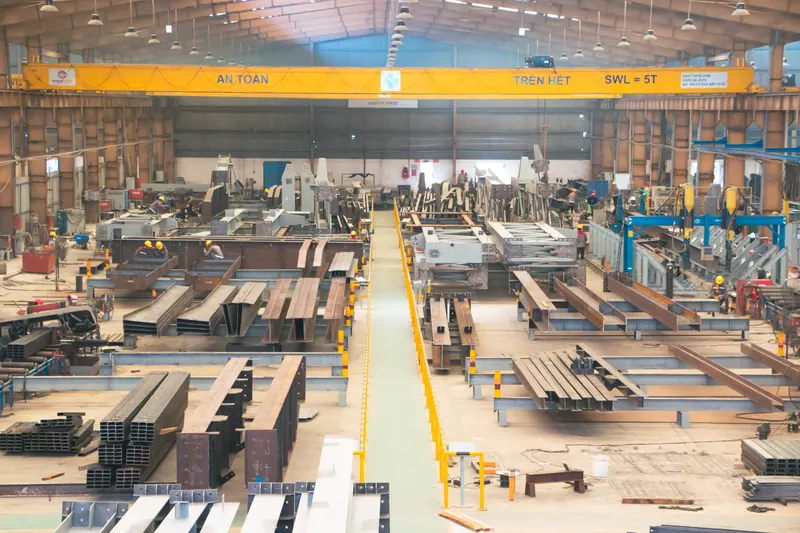
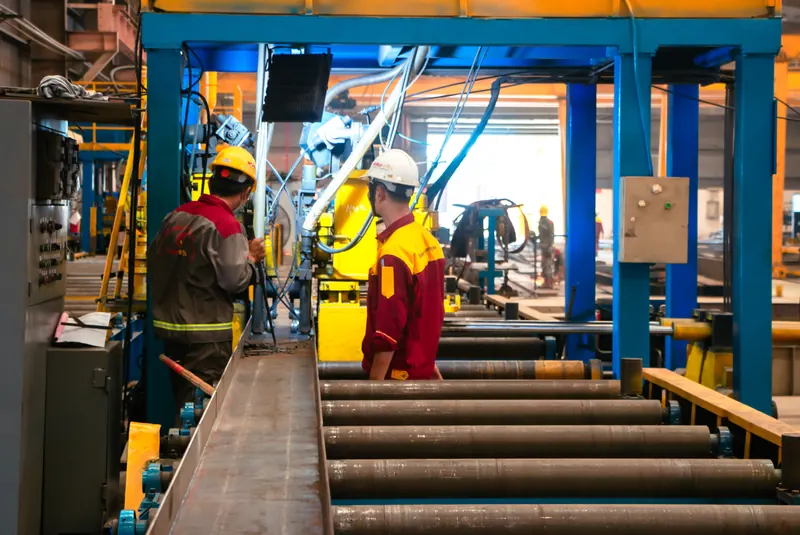
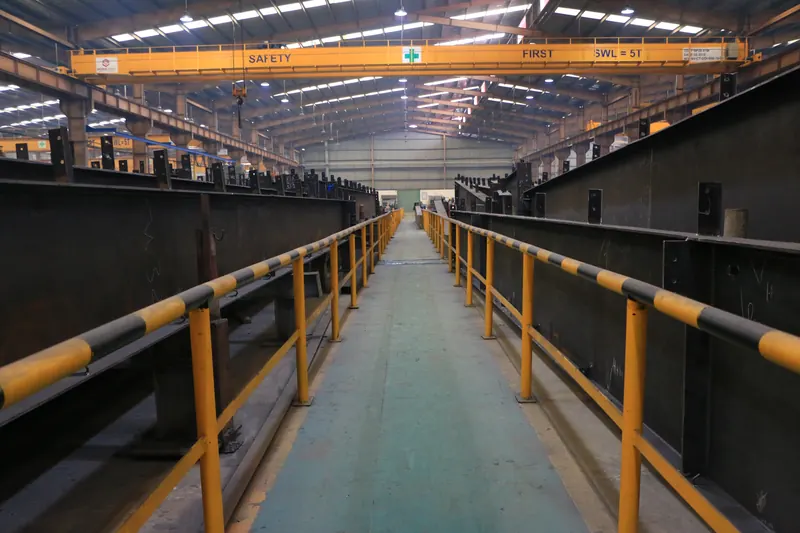
Fabrication halls and submerged arc welding in the World Steel plant, Vietnam.
Questions
Box girder questions
When is a box girder better than a plate girder?
When torsion, lateral stability or a curved alignment governs. If the girder only bends about one axis and can be braced, a plate girder is usually lighter and quicker to make.
How is the inside of a box girder protected from corrosion?
Either it is sealed completely so no moisture gets in, or it gets access openings so it can be blasted, coated and inspected. The choice is made in design and shown on the approval drawings.
Are box girder corner welds full penetration?
Only where your design calls for it. Many box girders use fillet or partial penetration corner welds along most of the length, with complete penetration near splices and heavy load points.
How are long box girders shipped?
In segments joined by bolted or field-welded splices, each sized for a container, flat rack or breakbulk slot, match-marked and weighed in kg (lb).
Can box girders carry a concrete deck?
Yes, when your design uses shear connectors on the top flange. Studs are usually field-welded through the deck by the US contractor, our customer; we prepare the flange for them.
Built for large jobs
Box girders for your next large package
Our own plant in Vietnam fabricates 2,500 metric tons of structural steel a month, is accredited under IAS AC472 since 2019 and is audited twice a year. Shop drawings are included on every project.
- 5,000 tSunpro Steel Factory
- 2,500 tCPV Food Processing Factory
- 2,000 tLong Son petrochemical complex
- 2,000 tM&D (MD Factory)
Request a quote
Send drawings, a model or a member schedule. Our engineers check the US code basis, size or verify the members and price the fabricated steel, delivered to your US port.
Become our partner in the US
You erect and own the customer; we design, fabricate and ship. Engineering support on your bids and supply under your brand.
Who approves the design. We prepare calculations and drawings ready for your Engineer of Record’s review and approval. The PE seal and the permit stay with the US contractor, our customer.
Shop drawings, included