Every rule in AISC 341 ends up in someone's hands: a fitter positioning a continuity plate, a welder running a demand-critical root pass, an erector pretensioning a bolt, an inspector holding an ultrasonic probe. If those hands do not know which member is ductile, where the protected zone is or which weld is demand critical, the design does not reach the building. Two chapters of AISC 341-22 deal with that last mile. Chapter I, Fabrication and Erection, sets how the seismic system is made and assembled. Chapter J, Quality Control and Quality Assurance, sets who checks it and how; in 2022 it was restructured to align fully with Chapter N of AISC 360-22. This article explains both chapters from the point of view of seismic steel fabrication.
Chapter I: making the seismic system
Section I1: shop and erection drawings
Chapter I starts with documents. Shop drawings for the seismic force-resisting system (SFRS) must show the items the design drawings designate under Section A4: which members and connections belong to the SFRS, the locations and dimensions of protected zones, the demand-critical welds, the access hole, backing and weld tab requirements, and the bolted joints that need prepared faying surfaces. Erection drawings must show the same information for the field: protected zones, field welds and bolts in the SFRS, and their requirements. For composite systems, the drawings also show steel anchors, reinforcing interfaces and concrete placement requirements that affect the steel.
Section I2: fabrication and erection
Section I2 turns the drawings into rules for the work:
- Protected zones (I2.1): discontinuities created by fabrication or erection in a protected zone, such as tack welds, erection aids, arc strikes and gouges, must be repaired as the Engineer of Record approves. Attachments are not made there except as the standard permits.
- Bolted joints (I2.2): faying surfaces are prepared to the required slip class and protected until assembly, holes are made to the specified type, and bolts are installed and pretensioned to the RCSC Specification.
- Welded joints (I2.3): welding follows AWS D1.1 and D1.8, with procedures, filler metal, tack welds, backing and weld tabs handled as those codes require.
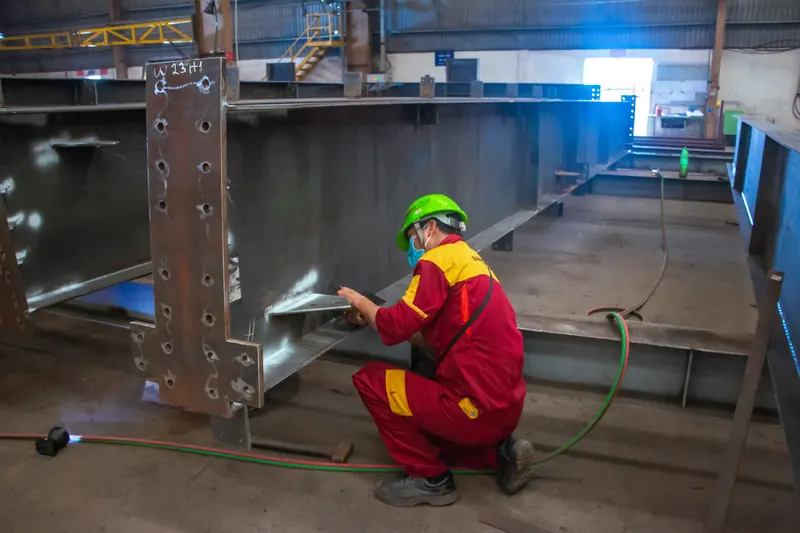
- Continuity plates and stiffeners (I2.4): corner clips are made to the required dimensions so welds stay out of the column k-area.
Section I3: composite construction
For composite systems, Section I3 adds requirements for the concrete and reinforcing steel, for steel anchors such as headed studs, and for the sequencing of concrete placement around steel elements.
Chapter J: who checks what
Two roles: QC and QA
Chapter J separates two roles, the same way AISC 360 Chapter N does:
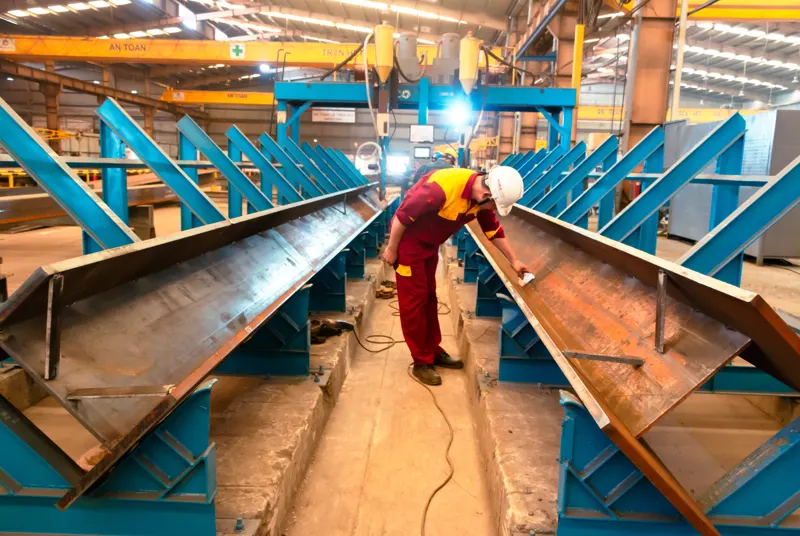
- Quality control (QC) is performed by the fabricator for shop work and the erector for field work. It is their own inspection of their own work, carried out by their quality control inspectors under a written program.
- Quality assurance (QA) is performed by an independent agency engaged by the owner, or by the authority having jurisdiction, under IBC Chapter 17. It verifies that the work and the QC records meet the contract documents.
Neither replaces the other. QC builds quality in; QA confirms it.
The 2022 restructuring
In earlier editions, the seismic inspection rules in AISC 341 Chapter J had their own structure, which overlapped with but did not exactly match AISC 360 Chapter N. AISC 341-22 rewrote Chapter J to align with Chapter N. The documents, personnel qualifications and inspection task tables now follow the same order and terms, and Chapter J adds the seismic-specific items on top. For a fabricator, it means one quality program covers both; for a special inspector, one inspection and test plan structure covers the whole steel package.
Documents
Chapter J lists the documents the fabricator and erector must make available, including:
- Shop and erection drawings showing the SFRS items.
- Welding procedure specifications (WPS) and procedure qualification records (PQR), including the AWS D1.8 requirements.
- Filler metal certifications, including toughness and heat input envelope testing for demand-critical welds.
- Mill test certificates for the steel, with Charpy results where required.
- Welder qualification records, including the supplemental tests D1.8 requires for some demand-critical welds.
- Bolt and fastener certifications and installation records.
- Their written QC procedures and inspection records.
The QA agency, in turn, keeps its own documents: its procedures, inspector qualifications and inspection reports.
Personnel
QC and QA inspectors must be qualified. Welding inspectors are typically qualified under AWS B5.1 or as AWS Certified Welding Inspectors, with associate inspectors working under supervision. Nondestructive testing technicians are qualified under ASNT practice, and ultrasonic technicians for seismic work also meet the AWS D1.8 requirements for UT of demand-critical welds.
Inspection tasks: observe, perform, document
Like Chapter N, Chapter J organizes inspection in task tables for welding, bolting and other steel work, before, during and after the operation. Each task is marked for QC and for QA as:
- Observe (O): inspect on a random basis; operations are not delayed waiting for the inspection.
- Perform (P): perform the task for each weld, bolted joint or element before final acceptance.
- Document (D): record the inspection and its result.
Seismic-specific tasks include checking that demand-critical welds use the right filler metal and procedure, verifying backing and weld tab removal, inspecting the k-area after welding continuity plates and doublers, and inspecting protected zones for attachments and damage.
Nondestructive testing
Chapter J sets the minimum NDT for the SFRS. In outline:
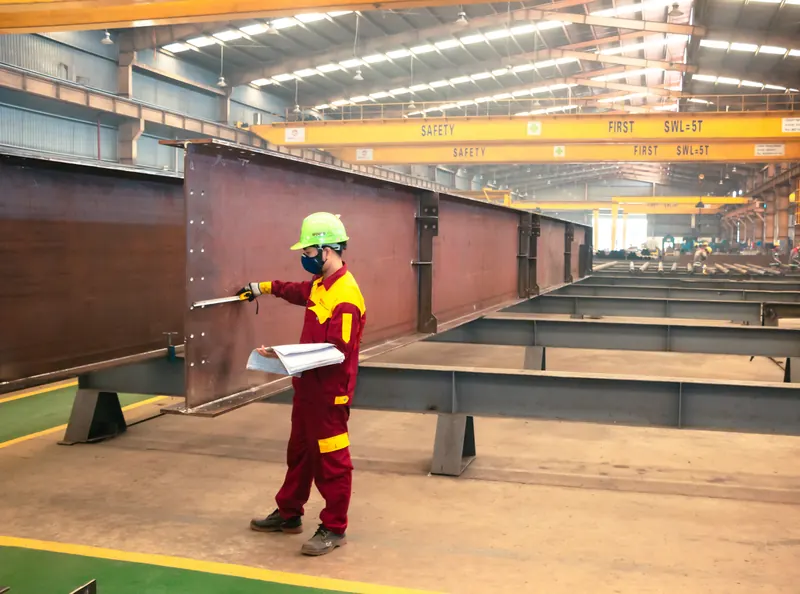
- Visual inspection of all welds.
- Ultrasonic testing (UT) of complete-joint-penetration groove welds in the SFRS, in material above a minimum thickness, at the rate the chapter sets, with provisions to reduce it for welders with low reject rates.
- Magnetic particle testing (MT) where weld tabs and backing are removed on demand-critical welds, and at the k-area after welding of continuity plates and doublers where required.
- Base metal testing: UT of thick base metal next to CJP welds where through-thickness tension could reveal laminations, and checks at access holes and copes in heavy sections.
- Repairs: inspection of repaired areas, such as gouges in protected zones or repaired reduced beam section cuts.
The project specification can require more; it cannot require less.
Shop QC versus field QC
Seismic steel fabricated in a controlled shop has a quality advantage: welding positions, preheat, heat input and inspection access are all easier than in the field. That is one reason many US seismic designs favor shop-welded, field-bolted details. The erector's QC on site then concentrates on bolting, field welds where unavoidable, plumbness and protecting the zones that the shop kept clean.
When the shop is overseas
For steel fabricated outside the United States, the same rules apply. The QA agency can inspect at the plant, or the building official may accept other evidence. IBC Section 1704.2.5 allows the building official to waive special inspection of shop work done by an approved fabricator, and accreditation such as IAS AC472 is the evidence many officials accept. Only the building official can make that decision; field QA continues regardless.
Common findings at seismic inspections
Inspectors on seismic steel projects tend to find the same handful of issues:
- Tack welds or erection aids left in protected zones, sometimes added after the shop for convenience on site.
- Weld tabs not removed or weld ends not ground on demand-critical welds.
- Backing left in place where the connection requires removal and a reinforcing fillet.
- Filler metal mix-ups, with a general-purpose electrode used on a demand-critical joint.
- Faying surfaces painted with a coating not qualified for the slip class.
- Missing records, so a weld that was made correctly cannot be shown to have been.
Each of these is easier to prevent than to fix, which is why Chapter J asks for inspection before and during the work, not only after it.
Checklist for a seismic quality program
- Are SFRS members, protected zones and demand-critical welds shown on shop and erection drawings?
- Are WPS and PQR documents in place for every seismic weld, including D1.8 requirements?
- Are filler metal toughness and heat input envelope records available?
- Are welders qualified, including any supplemental D1.8 tests?
- Is there an inspection and test plan listing each Chapter J task as O, P or D for QC and QA?
- Are UT and MT technicians qualified for seismic work?
- Are protected zones inspected before coating and before shipping?
- Are records kept per member so the QA agency can trace them?
How World Steel runs seismic fabrication and QC
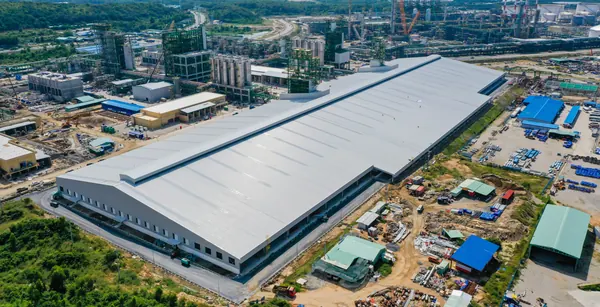
World Steel fabricates seismic steel for US projects in its own plant in Vietnam, the first and only fabricator in Vietnam accredited under IAS AC472, audited twice a year by IAS experts. Our quality program follows AISC 360 Chapter N and AISC 341 Chapter J: shop drawings, included at no extra cost, carry every SFRS item; WPS and PQR records cover AWS D1.8 requirements, see WPS and PQR; welders are qualified to D1.8; and demand-critical welds are inspected and tested as Chapter J and the project specification require. See weld inspection and NDT.
Each project gets an inspection and test plan agreed with the US contractor and the QA agency; you can review our sample ITP. The owner's inspector can witness hold points in person in Vietnam or remotely through inspector access, and every inspection, test and nonconformance is recorded per member in PEB Studio and our quality records. Materials are tested at ILAC-recognized ISO/IEC 17025 laboratories or at the laboratory the customer names. Field QC belongs to the US contractor, our customer, who completes the erection.
The next article, the last in this series, covers Chapter K: how seismic connections and braces are proven by cyclic testing.
Quick answers
Who does quality control and who does quality assurance under AISC 341?
Quality control is the fabricator's and the erector's own inspection of their work. Quality assurance is performed for the owner or the building official by an independent agency that verifies the work and the QC records.
What changed in Chapter J in AISC 341-22?
Chapter J was restructured to align fully with Chapter N of AISC 360-22, so the seismic inspection requirements use the same structure, terms and task tables as the rest of the steel quality program.
How much ultrasonic testing do seismic welds get?
Chapter J requires ultrasonic testing of complete-joint-penetration groove welds in the seismic force-resisting system in material above a minimum thickness, with provisions to reduce the rate for welders with good records, and magnetic particle testing at specific details. The project specification may add more.
Can the owner's inspector check steel fabricated overseas?
Yes. The QA agency can inspect at the plant in person, or the building official may accept other arrangements. At World Steel, inspectors can witness hold points in person or remotely and review records online.
Keep building your steel plan
Go further on USPEB.com
On this topic
Across the US market
- Quality hubInspection, testing and sign-off at the plant
- IAS AC472 accreditationThe first and only AC472 plant in Vietnam
- Accredited testing labsILAC ISO/IEC 17025 testing on every project
- Online factory auditWalk the shop live with our QA team
- Large projects, 2,500 t a monthCapacity for large US general contractors
- Contractor partnershipLong-term supply for US contractors