A steel plate shear wall looks almost too simple to work: a thin steel plate, often only a few millimeters thick, welded or bolted inside a frame of beams and columns. Yet in a major earthquake it is one of the most ductile and robust lateral systems available in steel. The secret is that the plate is allowed to buckle. Once it does, it carries the shear not by resisting buckling but by diagonal tension, a mechanism known as tension field action. AISC 341-22 Section F5 governs the steel plate shear wall (SPSW), and the 2022 edition simplified how the tension field is handled in design. This article explains how SPSWs work and what the rules require.
How the tension field works
Imagine a square frame with a thin plate filling it. Push the top of the frame sideways, and the plate is sheared. A thick plate would resist that shear directly, but a thin plate soon buckles into a series of diagonal waves. Along the direction of those waves, the plate is stretched; across them, it is slack. The plate now behaves like a field of inclined tension straps running corner to corner, and those straps carry the lateral load into the frame.
As the load grows, the straps yield in tension, dissipating energy. When the load reverses, the plate buckles the other way, and a new tension field forms in the opposite diagonal. The result is a system with high stiffness, high strength and stable energy dissipation, with the plate yielding across its whole area rather than at a few hinges.
ASCE 7 assigns special steel plate shear walls R = 7, with Ω0 = 2 and Cd = 6.
The parts of an SPSW
- The web plate: the thin plate that forms the tension field. It is the designated yielding element.
- Horizontal boundary elements (HBE): the beams above and below each web plate. They anchor the vertical component of the tension field.
- Vertical boundary elements (VBE): the columns at each side. They anchor the horizontal component of the tension field and carry the overturning.
- Web connections: the welds or bolts, often through a fish plate, that connect the web to the HBE and VBE.
The tension field angle: the 2022 change
The tension field forms at an angle, α, from the vertical. Its value affects how much of the web's strength is developed and how the forces load the HBE and VBE. Earlier editions calculated α from the web thickness, the panel dimensions and the areas and stiffness of the boundary elements, using a formula that often required iteration, because the boundary members were being sized at the same time.
AISC 341-22 changed the approach: the stiffness and shear strength of the wall are now evaluated using an assumed value of the tension field angle. Research showed that the shear strength is not very sensitive to the exact angle within the practical range, so a fixed assumption gives results close enough while removing the iteration. For engineers, design becomes faster and more transparent; for the system's behavior, nothing changes.
The change also helps checking. A plan reviewer or a peer reviewer can now follow the wall design without reproducing an iteration, and a change to a boundary column late in design no longer forces the engineer to recompute the angle and re-size every web. For fabricators, it means fewer late revisions to web thicknesses and fish plate welds once the shop drawings are under way.
Section F5: design rules
Web plates
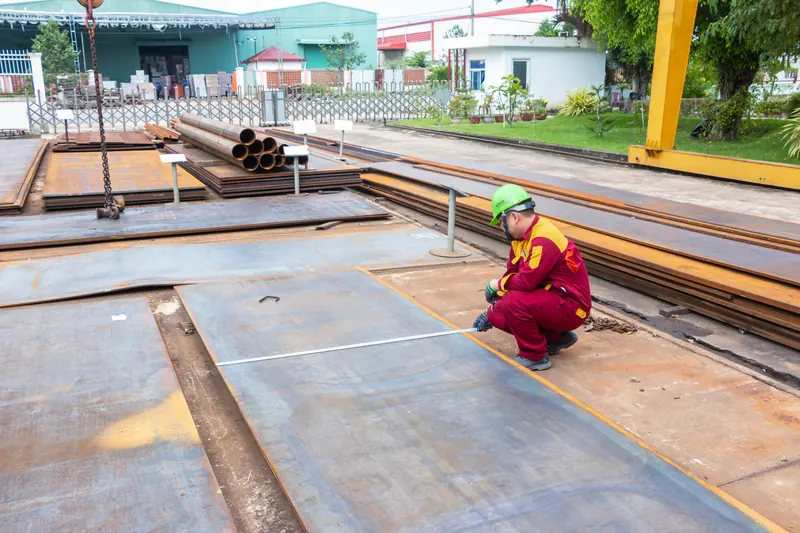
The web plate's shear strength is based on its yield stress, thickness and length, with the tension field angle. Webs are sized so the plate yields before the boundary elements, and the web may be thinner than any rolled plate a designer would use elsewhere, often 3 to 6 mm (1/8 to 1/4 in.). Very thin webs raise practical issues of handling, welding distortion and minimum thickness availability.
Panel proportions
Each panel's aspect ratio, its length to height, is limited to a range, roughly greater than 0.8 and not more than 2.5, within which the tension field forms reliably.
Boundary elements
HBE and VBE are designed by capacity design for the forces from the web plates yielding at their expected strength, plus gravity and other forces.
- VBE stiffness: the columns must have a minimum moment of inertia related to the web thickness and panel dimensions, so they do not bow inward under the pull of the tension field and leave the web partly ineffective.
- HBE: the beams must resist the vertical pull of the tension field from the web above and below; at the top and bottom of the wall, where the field acts from one side only, the HBE can be very heavy.
- Ductility: HBE and VBE must meet the highly ductile width-to-thickness limits of Table D1.1.
- HBE-to-VBE connections are moment connections that must meet requirements set in the standard, because the frame provides backup resistance and participates in drift.
Web connections
The connections of the web to the boundary elements must develop the expected tensile yield strength of the web at the tension field angle, so the web yields before its connection fails. In practice this is often a fillet-welded fish plate along each edge, or a bolted connection designed for the same force.
Perforated webs and corner cutouts
AISC 341 permits perforated webs, with a regular grid of circular holes that reduces the web strength in a predictable way, and webs with reinforced corner cutouts, which let services pass at the corners. Perforations are useful when the thinnest practical plate is still stronger than needed, because reducing web strength also reduces the forces on the boundary elements.
Protected zones
The protected zones of an SPSW include the web plates, the connections of the webs to the HBE and VBE, and the plastic hinge regions at the HBE ends.
Where SPSW fits
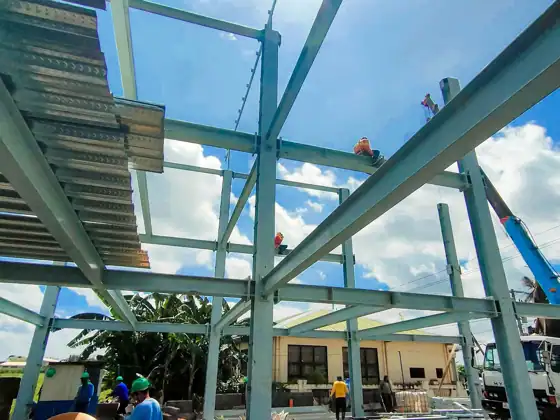
SPSWs suit tall and mid-rise buildings where wall space is available at the core or along party walls, especially when the walls need to be thin compared with concrete shear walls. A steel plate wall takes far less floor area than a concrete core and goes up with the steel frame, with no concrete curing in the schedule. They also suit retrofits, hospitals, and buildings in regions where both wind and seismic loads are high. Composite versions, with concrete on one or both sides of the plate, are covered in Chapter H and in the next article.
SPSW compared with other wall and brace systems
| Topic | Steel plate shear wall | Concrete shear wall core | Special concentrically braced frame |
|---|---|---|---|
| Wall thickness | Very thin web plus boundary columns | Thick walls, often 300 mm (12 in.) or more | No wall; braces need clear bays |
| Schedule | Rises with the steel frame | Formwork, rebar and curing before steel can follow, unless jump-formed ahead | Rises with the steel frame |
| Weight | Light | Heavy, raising seismic mass and foundation size | Light |
| Openings | Corner cutouts and perforations within limits | Coupling beams around openings | Chevron or other configurations around openings |
| Energy dissipation | Web yields over its whole area | Cracking and reinforcement yielding at the base | Brace buckling and tension yielding |
Owners often choose an SPSW when floor area is valuable, when the schedule cannot wait for a concrete core, or when the weight of a concrete core would push foundation costs up. In high-wind regions, the wall's stiffness also helps control drift and building motion.
Fabrication and erection notes
- Thin plate handling: webs can distort from welding heat; sequencing, restraint and fish plate details limit that distortion.
- Fish plates let the web be field-connected with tolerance; they are often shop-welded to the HBE and VBE.
- Panel squareness must be held to tolerance so the web fits without forcing.
- Boundary elements are often heavy built-up sections, especially at the top and bottom of the wall.
- Protected zones cover the entire web: no attachments, conduit clips or holes beyond the design.
A worked example in words
Consider a ten-storey building with an SPSW at each end of its core. At the lower levels, the shear is high, and the web plate is 6 mm (1/4 in.) thick; higher up, the shear falls and the web steps down to 4 mm (5/32 in.), and at the top floors a perforated web is used because even the thinnest practical plate is stronger than needed. The VBE are built-up box or heavy wide-flange columns sized for stiffness and overturning. The HBE at the roof and at the base carry the one-sided pull of the tension field and are the heaviest beams in the wall. The fish plates are shop-welded to the boundary elements, and the webs are field-welded or bolted to them on site, panel by panel.
How World Steel works on steel plate shear walls
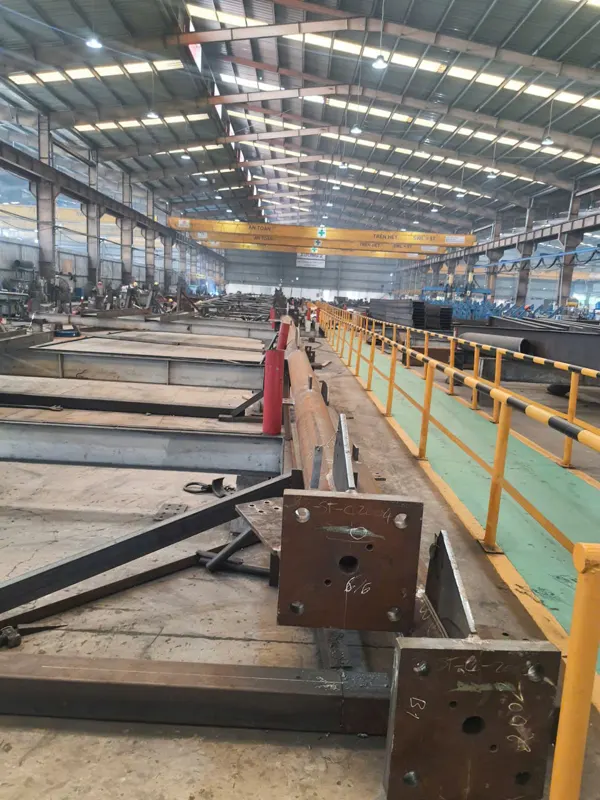
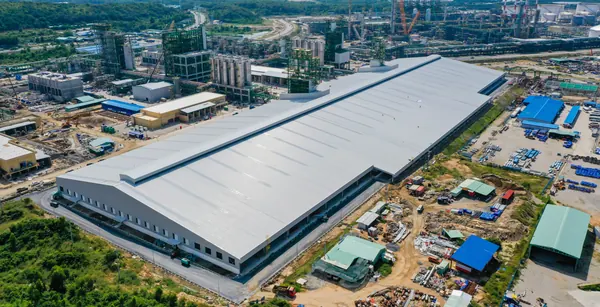
World Steel designs and fabricates steel for US multi-storey projects in its own IAS AC472-accredited plant in Vietnam, including the heavy boundary elements, fish plates and web plates of steel plate shear walls. We design or detail HBE and VBE for the capacity of the web, check VBE stiffness and HBE demands, and prepare shop drawings that show the web thicknesses, perforation patterns, fish plates and protected zones. Heavy VBE and HBE are made as built-up steel sections when rolled shapes are not enough, and plate thickness is checked against the EN 10204 3.1 certificate at intake.
Welders are qualified to AWS D1.8, panels are checked for squareness before shipping, and every element is tracked in PEB Studio. The Engineer of Record reviews and approves the design, and the US contractor installs the webs on site.
The next article turns to Chapters G and H: composite seismic systems and the new coupled composite plate shear wall.
Quick answers
How does a steel plate shear wall resist earthquakes?
Thin web plates inside a frame of beams and columns buckle under shear and then carry the load through diagonal tension, the tension field. The web yields in tension along the field, dissipating energy, while the boundary beams and columns stay strong enough to anchor it.
What changed for SPSW in AISC 341-22?
Instead of calculating the angle of the tension field from member properties, the 2022 edition evaluates the wall stiffness and shear strength using an assumed angle, which simplifies design without changing the system behavior.
What are HBE and VBE?
HBE are horizontal boundary elements, the beams above and below each web plate, and VBE are vertical boundary elements, the columns at each side. They must be stiff and strong enough to anchor the tension field.
Can SPSW webs have openings?
Yes. AISC 341 permits perforated webs with a regular pattern of circular holes and webs with reinforced corner cutouts, within its rules, which can reduce web strength to suit the demand or allow services to pass.
Keep building your steel plan
Go further on USPEB.com
On this topic
Across the US market
- US codes and standardsIBC, AISC, AWS and MBMA, designed to
- Seismic steel structuresSDC D to F framing for West Coast jobs
- Crane building designUS crane standards for mill and bay buildings
- Design ReportWhat our US-code design report contains
- Large projects, 2,500 t a monthCapacity for large US general contractors
- Contractor partnershipLong-term supply for US contractors