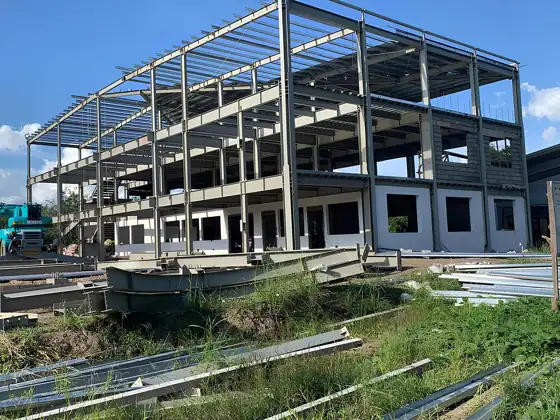
Every six years the American Institute of Steel Construction updates its Seismic Provisions for Structural Steel Buildings, ANSI/AISC 341. The current edition, AISC 341-22, works hand in hand with AISC 360-22 for general steel design, ASCE/SEI 7-22 for loads and AISC 358-22 for prequalified moment connections. It is the edition the 2024 International Building Code references, so as states adopt IBC 2024 it becomes the rule on most new seismic steel work in the United States.
For a general contractor, a design-build firm or a structural engineer, the question is practical: what changed from AISC 341-16, and what does that change on the drawings, in the shop and at the inspection? This article, the first of a twenty-part series, gives the overview. Each later article takes one chapter or one system and goes into depth.
What AISC 341 is for
AISC 341 does not make steel stronger. It makes a steel frame tough. ASCE 7 lets a building resist a major earthquake with a design force far below the elastic force the ground motion would produce, by dividing that force by the response modification coefficient R. The price of that reduction is ductility: certain members and joints must yield, stretch and bend through many cycles without fracturing, while everything around them stays strong enough to let that happen.
AISC 341 is the rulebook for that behavior. It decides which steels may be used, how slender a flange may be, where nothing may be welded or drilled, which welds must be notch-tough, how connections are proven by testing and how the work is inspected. The basic ideas have not changed in 2022. What changed is how clearly they are written and how many systems they now cover.
About thirteen significant technical changes
Industry summaries of the 2022 edition count about thirteen significant technical changes between the 2016 and 2022 editions. They fall into four groups.
Materials and drawings (Chapter A)
- Table A3.1 was reorganized. The list of steels permitted in the seismic force-resisting system (SFRS) is now presented in one table that sets out each specification, its strength and its limits, which makes it far easier to check a mill certificate against the rules.
- ASTM A709/A709M was added. The bridge steel specification is now formally permitted for members of the SFRS. That helps when a project already buys A709 plate, for example on mixed bridge and building work.
- Drawing and specification requirements were reorganized to align with Section A4 of AISC 360-22, so the information an engineer must show on the structural design drawings is now listed in the same order in both standards.
General design and member requirements (Chapters B, C and D)
- Section B5 on diaphragms, chords and collectors spells out more clearly how seismic forces travel from floors and roof trusses into the vertical frames, and which elements must be designed with overstrength.
- Table D1.1 was updated. The width-to-thickness limits that classify members as moderately ductile or highly ductile were adjusted, with revised equations for webs of I-shapes and channels and for the walls of box sections.
- Design wall thickness for HSS is clarified: the provisions say when the design thickness of a hollow structural section, rather than its nominal thickness, must be used.
Steel systems (Chapters E and F)
- Special moment frames (SMF) gained new width-to-thickness rules for continuity plates and relaxed some weld requirements for them, which saves shop hours without weakening the joint.
- Cantilever column systems, ordinary (OCCS) and special (SCCS), received full provisions and commentary, with new rules for column bases and column bracing.
- Special concentrically braced frames (SCBF) now formally allow limited yielding of the beam in V-type and inverted-V-type bracing under the unbalanced load that develops once a brace buckles.
- Buckling-restrained braced frames (BRBF) got updated limits on how far test results may be extrapolated, which gives brace makers more flexibility in prequalifying their products.
- Steel plate shear walls (SPSW) changed the way the angle of the tension field is handled: stiffness and shear strength are now evaluated with an assumed angle, simplifying the design.
Composite systems and verification (Chapters G, H, J, K and Appendix 1)
- The coupled composite plate shear wall, concrete filled (CC-PSW/CF) is a new system in Chapter H, and the composite walls with steel coupling beams (C-OSW and C-SSW) gained rules on embedment length and transfer reinforcement.
- Chapter J on quality control and quality assurance was restructured to align fully with Chapter N of AISC 360-22.
- Appendix 1, Design Verification Using Nonlinear Response History Analysis, is new. It gives the steel-specific rules for modeling, ground motions and acceptance when a design is checked by nonlinear dynamic analysis.
Chapter by chapter: where the standard is organized
It helps to see the whole document before diving into the changes. AISC 341-22 is arranged in chapters that follow the life of a seismic system:
| Chapter | Subject | What it means on a job |
|---|---|---|
| A | General requirements | Scope, materials (Table A3.1), expected strength, heavy sections, welding consumables, drawings |
| B | General design requirements | Load combinations with overstrength, system type, diaphragms and collectors |
| C | Analysis | General and additional analysis requirements, nonlinear analysis |
| D | Members and connections | Ductility classes, bracing, protected zones, columns, bolted and welded joints, splices, bases |
| E | Moment-frame systems | OMF, IMF, SMF, STMF, OCCS, SCCS |
| F | Braced-frame and shear-wall systems | OCBF, SCBF, EBF, BRBF, SPSW |
| G | Composite moment frames | C-OMF, C-IMF, C-SMF, C-PRMF |
| H | Composite braced frames and walls | C-OBF, C-SCBF, C-EBF, C-OSW, C-SSW, C-PSW/CE, C-PSW/CF, CC-PSW/CF |
| I | Fabrication and erection | Shop and erection drawings, protected zones, bolted and welded joints |
| J | Quality control and quality assurance | Fabricator and erector QC, owner's QA, inspection tasks, nondestructive testing |
| K | Prequalification and cyclic qualification testing | Connection prequalification, cyclic tests for connections and braces |
| Appendix 1 | Nonlinear response history analysis | Modeling, ground motions, acceptance criteria |
The series follows that order, so you can read straight through or jump to the system on your drawings.
What the changes mean for a general contractor
Most of the 2022 changes are design changes, made by the Engineer of Record and the steel designer. A few reach the contractor directly:
- Material substitutions get easier to check. With Table A3.1 reorganized, a proposed substitute grade is checked against one table. When a mill offers A709 plate in place of A572, there is now a clear path for it.
- Shop hours on SMF joints can come down. Relaxed weld rules for continuity plates mean less complete-joint-penetration welding at some joints, and less ultrasonic testing with it. Whether a job benefits depends on the details the engineer chooses.
- New systems open new options. Cantilever column systems now have complete rules, which matters for one-story canopies, carports and industrial structures where the columns alone resist lateral load. On tall buildings, CC-PSW/CF lets the core walls rise with the steel frame instead of waiting for a cast-in-place concrete core.
- Quality documents look more like AISC 360. Because Chapter J now mirrors Chapter N of AISC 360-22, the inspection and test plan for the seismic system follows the same structure as the rest of the steel package, which makes it easier for the special inspector and the building official to review.
What the changes mean for the structural engineer
For the Engineer of Record, the 2022 edition reduces ambiguity more than it adds work. The revised Table D1.1 may change a member's classification near the boundary between moderately and highly ductile, so section choices made under the 2016 limits are worth rechecking. V-braced SCBF beams can be lighter because limited yielding under the unbalanced load is now explicitly permitted. SPSW design no longer needs an iterative calculation of the tension field angle. And for performance-based designs of tall or irregular buildings, Appendix 1 finally gives steel-specific modeling and acceptance rules that work with Chapter 16 of ASCE 7-22.
Which edition applies to your project
The edition is set by law, not preference. The IBC adopted in your jurisdiction references a specific edition of ASCE 7 and, through it, a specific edition of AISC 341. IBC 2024 and ASCE 7-22 call for AISC 341-22; IBC 2018 and 2021 with ASCE 7-16 call for AISC 341-16. California, Washington, Oregon, Utah and other seismic states adopt the IBC with their own amendments on their own schedules, so the governing edition is confirmed with the Engineer of Record and the building official at the start of design. Mixing editions within one seismic system is not allowed.
How World Steel works to AISC 341-22
World Steel designs and fabricates structural steel for US projects in its own plant in Vietnam, the first and only fabricator in Vietnam accredited under IAS AC472. On seismic work we design to AISC 341-22, AISC 360-22 and ASCE 7-22 by default, or to the edition the project jurisdiction enforces. Our calculations and drawings go to the US contractor's Engineer of Record for review and approval; the US contractor, our customer, handles the permit and the site work.
In practice, that means:
- Design. Seismic systems are modeled and checked to the AISC 341 chapter for the chosen system, with expected material strength and capacity design built into the connection design. See steel building design and design optimization.
- Drawings. Shop drawings are included on every project at no extra cost. On seismic jobs they mark the ductility class of each member, the protected zones and the demand-critical welds.
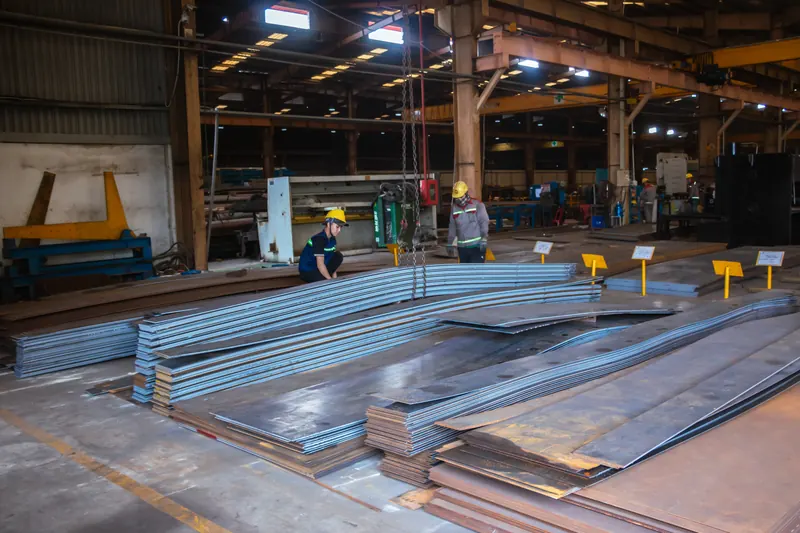
- Materials. Plate and sections are bought to the ASTM grades AISC 341 permits, with EN 10204 3.1 certificates and Charpy V-notch results on request. See material toughness and mill certificates.
- Welding. Shop welding procedures and welders are qualified to AWS D1.8, the seismic supplement AISC 341 calls up. See the AWS D1.8 standard page.
- Quality. Inspection and testing follow Chapter J and your project specification, and your special inspector can witness hold points in person or remotely through inspector access.
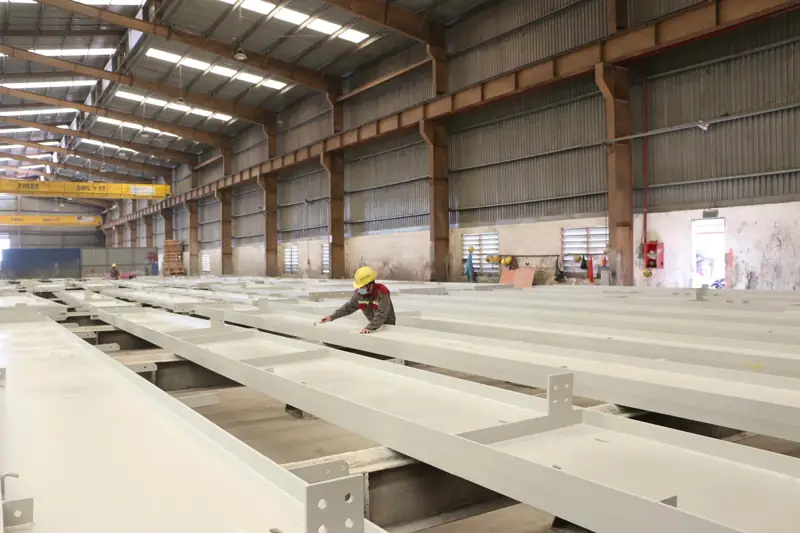
- Capacity. Our own plant fabricates 2,500 t of steel a month, enough for large multi-storey and industrial seismic projects, and every member can be tracked in real time in PEB Studio.
The rest of this series explains each part of AISC 341-22 in the same practical way. Start with the next article on how AISC 341 fits with AISC 360, ASCE 7 and AISC 358, or go back to the AISC 341 standard page for the full chapter map.
Quick answers
Which building codes adopt AISC 341-22?
ASCE/SEI 7-22 and the 2024 International Building Code reference AISC 341-22. Jurisdictions still on an older IBC usually reference AISC 341-16, so the edition is confirmed with the Engineer of Record before design starts.
Is AISC 341-22 a complete rewrite?
No. The philosophy of capacity design, ductile detailing, protected zones and seismic quality assurance is unchanged. The 2022 edition reorganizes material and drawing requirements, refines several systems and adds new ones.
What is new in AISC 341-22 for composite construction?
Chapter H adds the coupled composite plate shear wall with concrete fill, CC-PSW/CF, and updates the provisions for composite shear walls with steel coupling beams.
Does World Steel design to AISC 341-22?
Yes. World Steel designs and fabricates steel seismic systems to AISC 341-22 with AISC 360-22 and ASCE 7-22 by default, or to the edition your jurisdiction enforces, and the US contractor’s Engineer of Record reviews and approves the design.
Keep building your steel plan
Go further on USPEB.com
On this topic
Across the US market
- US codes and standardsIBC, AISC, AWS and MBMA, designed to
- Crane building designUS crane standards for mill and bay buildings
- Design ReportWhat our US-code design report contains
- Large projects, 2,500 t a monthCapacity for large US general contractors
- Contractor partnershipLong-term supply for US contractors
- Solutions by stateState-by-state steel solutions