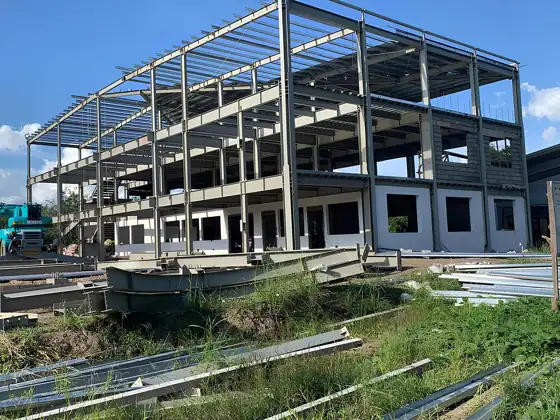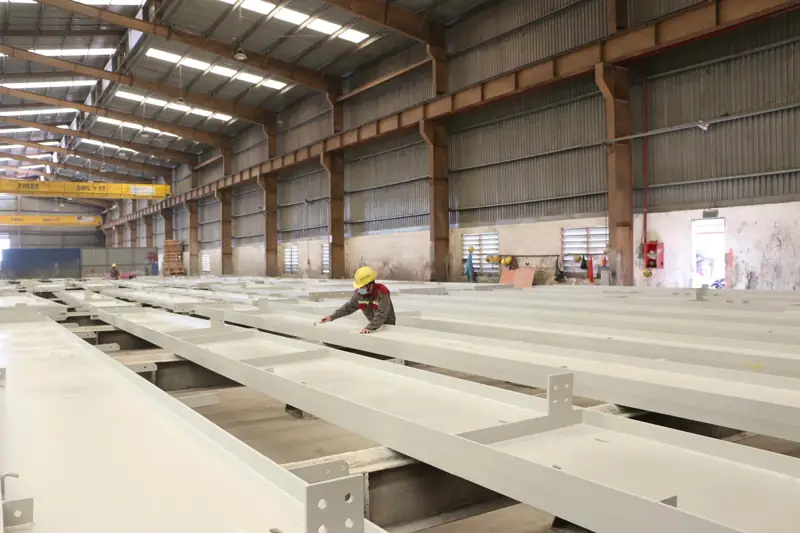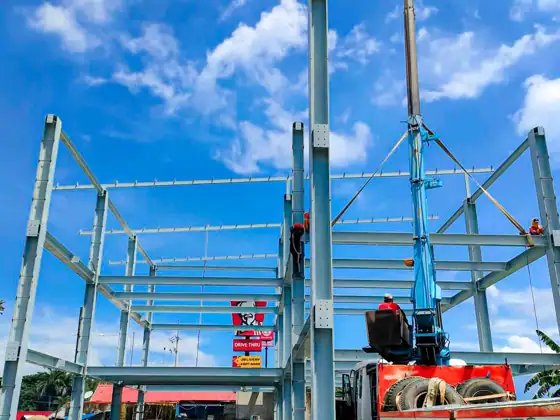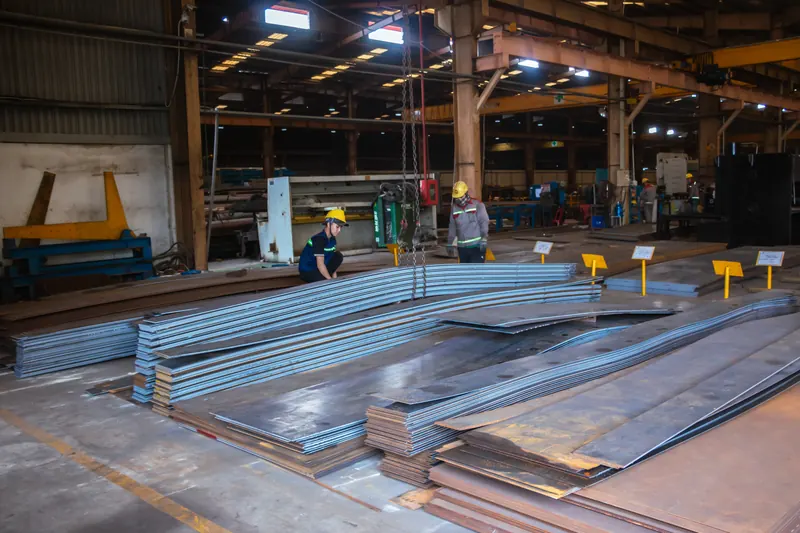
Ductility starts at the steel mill. A seismic frame can only stretch and bend through a major earthquake if the steel itself is ductile, predictable and tough, and if the designer knows how strong it really is. That is why the first technical section of AISC 341, Section A3, is about seismic steel materials: which specifications are permitted, how strong they are expected to be, and when the base metal and the welding consumables must prove their toughness. The 2022 edition reorganized Table A3.1 and added ASTM A709. This article explains the rules and what they mean for buying, checking and tracing steel.
Why seismic systems need their own material rules
In ordinary steel design, a stronger steel is simply better: more strength for less weight. In seismic design, that is not always true. The yielding member, a beam in a moment frame or a brace in a braced frame, is chosen to be the weak link. Every other element is designed to be stronger than it. If the steel in the yielding member turns out far stronger than its grade, the weak link is no longer weak, and the force goes somewhere it was never meant to go: a weld, a column or a connection plate.
So AISC 341 needs two things from the steel. First, a ductile, well-understood product, made to a specification with a proven yield plateau, enough elongation and a sensible ratio between yield and tensile strength. Second, a reliable estimate of actual strength, so the elements around the yielding member can be designed for it.
Table A3.1: one place for permitted steels
Section A3.1 lists the steels that may be used in the seismic force-resisting system (SFRS). In AISC 341-22 this information was gathered and reorganized into Table A3.1, which sets out each permitted specification and grade together with its strength values and the limits that apply. Instead of hunting through text, notes and a separate table, a designer or a fabricator can now read a grade's status in one row.
The permitted family is familiar to anyone who buys structural steel in the US:
- Hot-rolled shapes: ASTM A992 for wide-flange shapes, A36, A572 in its common grades, A588 weathering steel, A913 quenched and self-tempered shapes and A1043 low-yield-ratio steel.
- Hollow structural sections: ASTM A500, A501, A1085 and A53 pipe, within the grades listed.
- Plates and bars: ASTM A36, A572, A588, A1011 HSLAS sheet in some uses, A1043 and others listed in the table.
- New in 2022: ASTM A709/A709M, the specification for structural steel for bridges, within the grades and limits Table A3.1 gives.
Why add a bridge specification? A709 grades are produced to tight chemistry and toughness requirements and are widely available as plate. On projects that combine buildings with bridges, platforms or industrial structures, or where a mill supplies A709 more readily than A572, the designer can now specify it for the SFRS without a variance.
The yield stress cap on yielding members
Section A3.1 also caps the specified minimum yield stress, Fy, of members in which inelastic behavior is expected. For most systems in Chapters E through H, that cap is 345 MPa (50 ksi). A slightly higher limit applies to some ordinary systems and to columns that are not expected to yield, and higher-strength grades can be used in elements designed to stay elastic. The standard gives the exact list.
The reason is the same as before: higher-strength steels generally have a higher yield-to-tensile ratio and less margin between first yield and fracture. A member that must yield through many cycles is better served by a grade whose behavior has been tested extensively in seismic research.
Expected strength: Ry and Rt
Mill steel is almost always stronger than its minimum grade, and some grades are much stronger. AISC 341 accounts for that with two factors, given for each specification in Table A3.1:
- Ry, the ratio of expected yield stress to specified minimum yield stress.
- Rt, the ratio of expected tensile strength to specified minimum tensile strength.
Two examples show the range. For ASTM A992 wide-flange shapes, Ry is 1.1, so a 345 MPa (50 ksi) beam is expected to yield at about 380 MPa (55 ksi). For ASTM A36 shapes, Ry is 1.5, because A36 shapes from modern mills commonly test far above 250 MPa (36 ksi). Values for plate, HSS and other grades are read from the table.
How expected strength drives the design
Expected strength is the heart of capacity design. In a special moment frame, for example, the probable maximum moment at the plastic hinge is based on Ry Fy times the plastic section modulus, increased further for strain hardening. The beam-to-column connection, the panel zone and the column are then designed for that moment, not for the code design moment. In a special concentrically braced frame, the brace connections are designed for the brace's expected tensile strength, Ry Fy Ag.
Expected strength may also be used on the resistance side in specific checks, such as the strength of the yielding member itself when its own connection is designed, and Rt is used for limit states such as fracture of the same member's net section. The result is a frame where the intended weak link really is the weakest element.
What this means when steel is substituted
Ry explains why a fabricator cannot freely swap one grade for another in a seismic system, even when the substitute is "stronger". Replacing A992 with a grade that has a higher Ry, or a higher Fy, raises the force the yielding member can deliver and may overstress the connection, the column or the brace gusset. Every substitution in the SFRS goes back to the Engineer of Record.
Heavy sections and Charpy toughness
Thick steel is more prone to brittle behavior than thin steel, because it cools more slowly at the mill and develops a coarser grain at its core. Section A3.3, heavy sections, therefore asks for Charpy V-notch (CVN) toughness tests on thick material in the SFRS:
- Hot-rolled shapes with flanges 38 mm (1-1/2 in.) and thicker.
- Plates 50 mm (2 in.) and thicker used in built-up members and in connection plates where inelastic strain under seismic loading is expected.
The requirement is a minimum of 27 J at 21 °C (20 ft·lbf at 70 °F), tested at the locations the referenced ASTM supplementary requirements specify. For a built-up box column or a heavy cruciform column, this is often the material test that decides which plate can be bought.
Welding consumables: toughness in the weld metal
Section A3.4 covers the consumables for welding. Welds in the SFRS must be made with filler metal that has a classified toughness of at least 27 J at −18 °C (20 ft·lbf at 0 °F). Demand-critical welds, those whose failure would compromise the system, must in addition meet the heat input envelope testing of AWS D1.8, with weld metal toughness of at least 54 J at 21 °C (40 ft·lbf at 70 °F), with adjustments for structures that will be colder in service. Our AWS D1.8 series covers these tests in detail.
Documents a buyer should ask for
For the steel in a seismic system, a general contractor or the special inspector should expect:
- Mill test certificates for every heat, showing specification, grade, chemistry, tensile results and, where required, CVN results.
- Traceability from the certificate to the piece mark, so each member in the SFRS can be traced to its heat.
- Filler metal certificates showing the classification and toughness, and the heat input envelope test records for demand-critical welds.
- Substitution records, approved by the Engineer of Record, for any grade that differs from the drawings.
A worked example: checking a plate for a box column
Consider a welded box column in a special moment frame, built up from four plates 60 mm (2-3/8 in.) thick. Before that plate is cut, four checks apply:
- Specification. The drawings call for ASTM A572 Grade 50. The certificate must show A572 Grade 50, and that grade must appear in Table A3.1 for plate in the SFRS.
- Strength. The reported yield and tensile strengths must meet the specification. They will usually exceed it, which is exactly what Ry and Rt anticipate.
- Toughness. At 60 mm the plate is above the 50 mm (2 in.) threshold of Section A3.3, and as part of a built-up column it may see inelastic strain at the panel zone, so the certificate must show Charpy results of at least 27 J at 21 °C (20 ft·lbf at 70 °F) at the specified location.
- Traceability. The heat number on the certificate must match the heat number stamped or stenciled on the plate, and it must follow every part cut from that plate to the finished column.
If any check fails, the plate is quarantined and does not enter the seismic system. The same logic applies to every wide-flange shape with flanges 38 mm (1-1/2 in.) and thicker.
How World Steel handles seismic steel materials
World Steel buys plate and sections to the ASTM grades the drawings specify, mainly from Vietnamese mills such as Hòa Phát, Formosa Hà Tĩnh, POSCO Vietnam, Hoa Sen and Nam Kim, and from mills in Japan, Korea, Indonesia or Thailand when the project specification calls for them. Vietnamese plate mills supply EN 10204 3.1 inspection certificates, with Charpy V-notch results on request, and every certificate is checked against the specification and Table A3.1 at intake. See EN 10204 3.1 mill test certificates.
Plate is stored by grade and heat number, and every cut part keeps its heat number through to its piece mark, so in PEB Studio you can open a seismic member and see the certificate behind it. Where a test is needed, materials are tested at ILAC-recognized ISO/IEC 17025 laboratories or at the laboratory the customer names; see accredited testing labs. Our built-up steel sections, including box and cruciform columns for heavy seismic frames, are cut on laser machines that handle plate up to 100 mm thick, and all of it is fabricated in our IAS AC472-accredited plant in Vietnam.
The next article moves from materials to paper: what AISC 341-22 Section A4 requires on the structural design drawings for a seismic system.
Quick answers
What is the yield stress limit for yielding members in AISC 341?
In most systems the specified minimum yield stress of members expected to yield may not exceed 345 MPa (50 ksi). Some ordinary systems and columns not expected to yield are allowed a little more; the exact limits are in Section A3.1.
What does Ry mean?
Ry is the ratio of expected yield stress to specified minimum yield stress. For ASTM A992 wide-flange shapes it is 1.1, and for ASTM A36 shapes it is 1.5. Capacity design uses Ry times Fy to size the elements around a yielding member.
When are Charpy V-notch tests required on the base metal?
Section A3.3 requires them for hot-rolled shapes with flanges 38 mm (1-1/2 in.) and thicker and for plates 50 mm (2 in.) and thicker in built-up members and connection plates where inelastic strain is expected: at least 27 J at 21 °C (20 ft·lbf at 70 °F).
Is ASTM A709 now allowed in seismic systems?
Yes. AISC 341-22 adds ASTM A709/A709M, the bridge steel specification, to the materials permitted in the seismic force-resisting system, within the grades and limits Table A3.1 lists.
Keep building your steel plan
Go further on USPEB.com
On this topic
Across the US market
- US codes and standardsIBC, AISC, AWS and MBMA, designed to
- Seismic steel structuresSDC D to F framing for West Coast jobs
- Crane building designUS crane standards for mill and bay buildings
- Design ReportWhat our US-code design report contains
- Large projects, 2,500 t a monthCapacity for large US general contractors
- Contractor partnershipLong-term supply for US contractors