Skip to content
Seeking US contractor partners IAS AC472 ACCREDITED ★ METAL BUILDINGS ★ AC472 IAS AC472 accreditedIAS AC472
World Steel USA

Hay and commodity storage

Hay and commodity storage: bays a loader can work

A commodity shed is a row of bays under one clear-span roof: hay stacked high in one, corn or meal pushed against a wall in the next, fertilizer kept dry at the end. A loader works every bay, so the columns stay out of the way and the frame carries the walls that hold the piles. Our plant fabricates 2,500 t of structural steel a month, so a co-op or feed mill can build its storage as one order.

In the bays this week

North bay
Hay, large squares
Bay two
Shelled corn
Bay three
Soybean meal
South bay
Fertilizer

One steel shed, every bay set for what it holds.

Pick the commodity

What each bay asks of the steel

Choose what goes in the bay to see the section and how walls, air and finish change.

PUSHWALL RIDGE VENT CLEAR SPAN · NO COLUMNS IN THE BAY

Hay

Walls
Open or half-clad sides, with bales stacked to the eave. The frame is kept clear of the stack so a loader or squeeze can reach every bale.
Air
Open sides or ridge vents let the stack breathe and shed the heat of curing hay.
Finish
Galvanized or painted frame. Fire separation between barns is set by the design team and the insurer.

Grain and corn

Walls
Concrete push walls by others, with steel columns and girts designed for the pile pressure the design team sets.
Air
Closed walls and a sealed roof keep rain and birds out; vents stop condensation under the roof.
Finish
Paint or galvanizing, with the bottom of the column kept above the pile line where the design allows.

Meal and feed ingredients

Walls
Bays with push walls on three sides, tall enough for the loader bucket, and a front open to the alley.
Air
Closed building with roof vents; dust control is by others.
Finish
A paint system that can be washed down, with smooth details that do not hold dust.

Fertilizer

Walls
Push walls carry the pile; steel stays above it. Liners or coatings at the wall top are set for the product.
Air
Closed and dry, because many fertilizers take up moisture and cake.
Finish
A coating system chosen for the salts in the product, often a duplex system, and sealed fasteners in the roof and walls.

The shed itself

Four parts of a commodity shed

Clear-span frame

Rigid frames span the whole shed, so the loader works every bay without a column in the way.

Rigid frame systems →

Wall girts above the push wall

Girts and cladding start above the concrete wall, out of reach of the bucket and the pile.

Wall girts →

Vents and louvers

Ridge vents and louvers sized for the commodity, from open hay barns to closed fertilizer sheds.

Roof ventilators →

Repeat customer

Haid Group: two feed plants from one plant

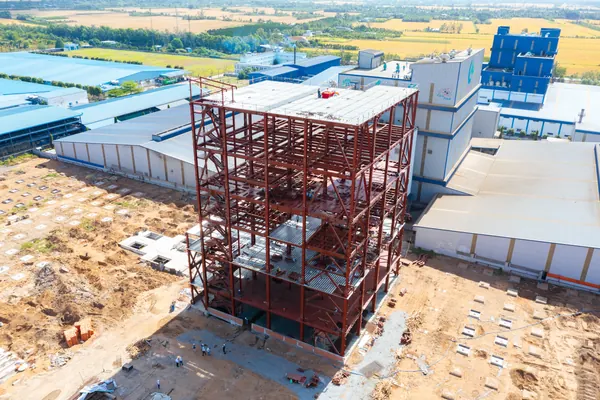
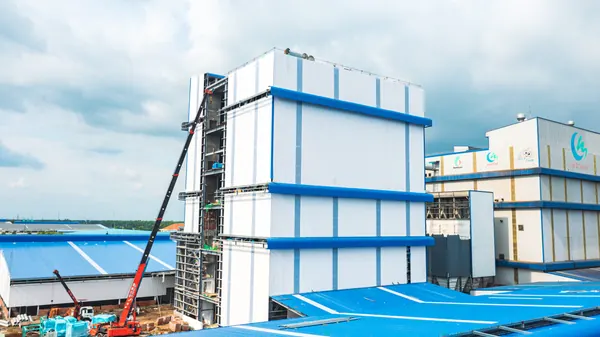
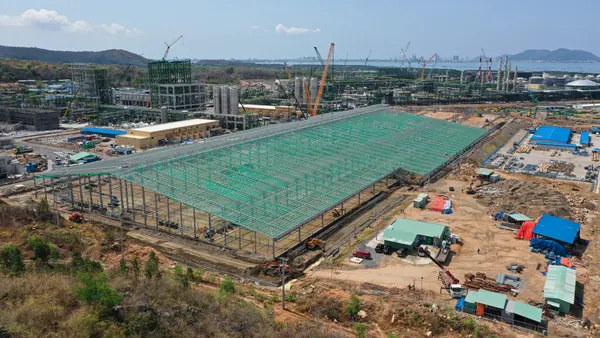
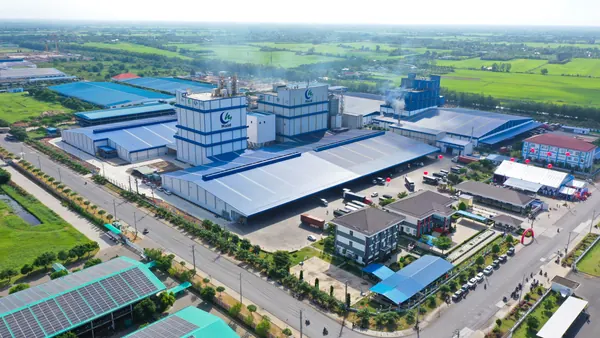
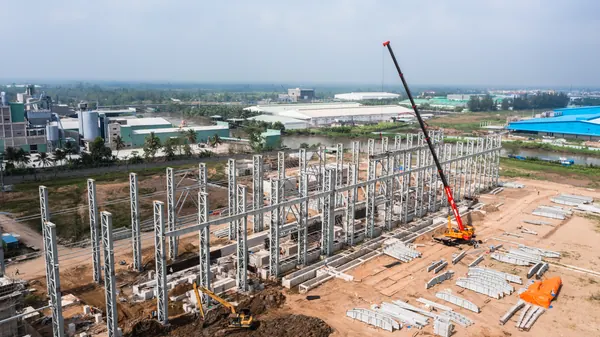
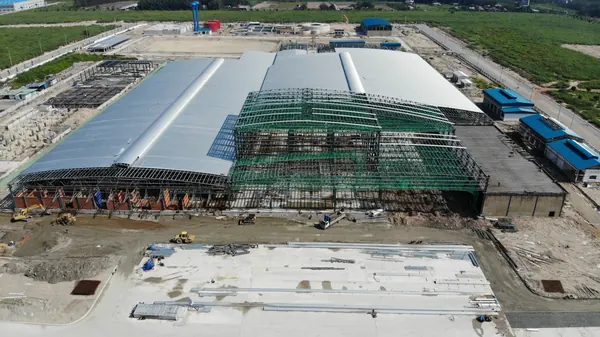
Haid Group came back to us for the steel of a second feed plant: Haid Vinh Long, shown here (2024), and Thang Long in Hai Duong. Each pairs raw material storage with a tall process tower. We do not have a US farm reference yet.
Our customers
Aerial view along the road of the Haid Vinh Long feed plant in Vietnam Photo
Red steel frame of the process tower going up beside the storage buildings at Haid Vinh Long Photo
Finished Haid Vinh Long feed plant with blue cladding seen across fields Photo
Crane beside the clad process tower and storage buildings of the Haid Vinh Long feed plant Photo

Scope, in writing

What we supply and what stays with your team

World Steel, our plant in Vietnam

  • Clear-span frames, girts above the push walls, roof and wall panels, vents and door framing designed to the contract documents
  • Coating systems chosen for the commodity, from paint to galvanizing by an outside galvanizer in Vietnam and duplex systems
  • Shop and erection drawings at no extra cost, ready for your Engineer of Record
  • Fabrication in our IAS AC472-accredited plant in Vietnam, tracked live in PEB Studio

The US contractor, our customer

  • Drawing approval, the PE seal and the permit with your Engineer of Record
  • Slab, concrete push walls and foundations
  • Conveyors, aeration, dust control and fire protection
  • Erection, envelope and doors

Questions from US contractors

Hay and commodity storage steel: questions and answers

6 answers, grouped by topic.

Bays and commodities 3 answers

Can one shed hold different commodities?

Yes. Each bay is set for its commodity: open sides for hay, push walls and closed walls for grain, meal and fertilizer. The frame is designed for the walls and loads of every bay.

Who builds the push walls?

The concrete push walls are by others. We design the steel columns and girts around them for the pile pressure the design team sets, and keep the steel above the pile where the design allows.

How is steel protected in a fertilizer shed?

With a coating system chosen for the product, often a duplex system, sealed fasteners and details that keep the steel out of the pile. The design team sets the system.

Feed mills and co-ops 3 answers

Have you built storage for feed plants?

Yes. Haid Group ordered the steel for two of its feed plants from us: Haid Vinh Long and Thang Long in Hai Duong. Both have raw material storage beside the process buildings.

What about a machine shed?

Machine and equipment sheds are covered on our agricultural steel buildings page, with wide clear spans and open sides for equipment.

Can a co-op build several sheds at once?

Yes. The plant fabricates 2,500 t of structural steel a month, so sheds for several sites can be fabricated together and shipped site by site.

Keep reading

Related pages

Price it or partner with us

Send the bay layout and the commodities.

Share the bays, what each holds, the wall heights and the loader. We will price the shed and its walls together.

Why US contractors price with us

2,500 t / month

Own plant capacity, about 2,750 short tons

IAS AC472

Accredited since 2019, audited twice a year

Up to 5,000 t

Largest single job: Sunpro Steel, 2024

See our largest jobs →

Short project form

Tell us about the building

Ask an engineer directly, or drop the basics below. You get a written scope of supply for a US-code building, checked by engineering first.

Or call +84 902 881 833
Or leave your project details