Buildings with overhead cranes behave differently from other steel structures. Every crane pass loads the runway, and over the building's life that adds up to millions of cycles. Runway beams that look fine on paper can crack within years if fatigue and tolerances are ignored.
Get the crane data first
The runway is designed around the crane, so the fabricator or designer needs:
- crane capacity and span;
- service class under CMAA (A to F), which reflects how often and how heavily it works;
- maximum wheel loads and wheel spacing;
- rail type and size;
- bridge, trolley and hoist weights and speeds;
- number of cranes on the runway and whether they can work together.
AISC Design Guide 7 sets out how these become design loads, including impact and lateral and longitudinal forces.
Fatigue
Fatigue governs many runway details. Points to check:
- Flange-to-web welds under the rail, which see a wheel load every pass.
- Stiffener welds near the top flange.
- Rail clips and splices.
- End stops and their attachment.
Use detail categories that suit the number of cycles, and avoid intermittent welds and abrupt changes in section where cracks can start.
Tolerances
Cranes run smoothly only on a straight, level runway. Typical items with tight limits include:
| Item | Why it matters |
|---|---|
| Rail span (center to center) | Prevents wheel flange binding |
| Horizontal alignment | Avoids skewing and wheel wear |
| Elevation and level | Prevents uneven wheel loads |
| Rail joints | Avoids impact at each joint |
The exact limits come from the crane manufacturer and AISC Design Guide 7. Shop fabrication should be held to the tighter of the two, and the erector needs adjustment details at the columns to achieve them on site.
Girder types
- Rolled beams with cap channels for light cranes.
- Built-up plate girders for heavier cranes and longer spans, where flange and web are chosen for the loads.
- Box girders for very heavy duty or torsion.
Columns and bracing
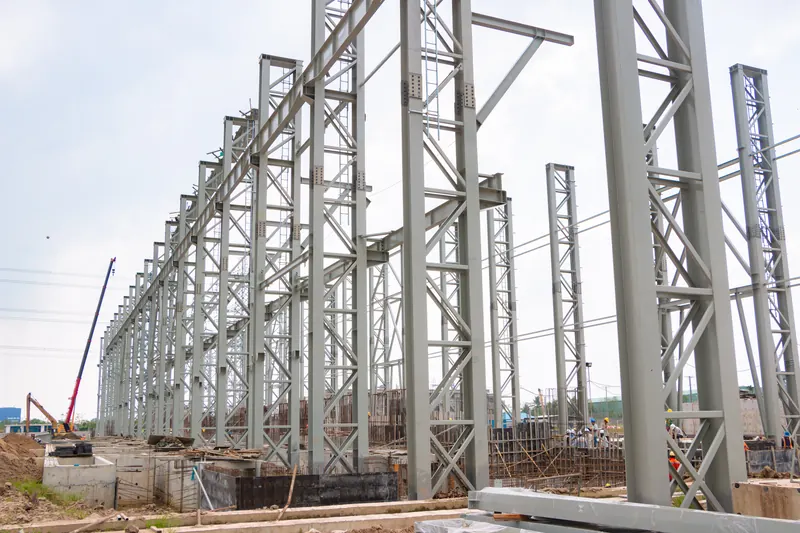
Crane columns are often stepped or laced, carrying the runway on a lower leg and the roof on an upper leg. Longitudinal bracing must take crane surge and braking forces to the foundations.
Coordination with the crane supplier
The crane manufacturer is a key partner in a crane building. Before the runway design is final:
- get certified wheel loads and spacing for the actual crane, not a generic value;
- confirm end stop forces, buffer types and the clearance envelope;
- confirm power supply arrangements, such as conductor bars, and their support brackets;
- agree who supplies and installs the rail, clips and pads.
Late changes to the crane, such as a heavier hoist or a second crane on the same runway, change runway and column design, so freeze the crane specification early.
Inspection before shipping
Because tolerances on site depend on accurate fabrication, inspect runway girders in the shop for:
- overall length and camber;
- flange tilt and web straightness;
- top flange flatness where the rail sits;
- hole positions for rail clips and seat connections;
- weld size and, where specified, NDT results for flange-to-web welds.
Record these checks by member mark so the erector knows which girder goes where.
Maintenance
Even a well-built runway needs inspection over time. Owners should plan periodic checks of rail alignment, clip tightness, end stops and welds at high-stress details. Good drawings and fabrication records make those checks faster.
Survey after erection
Survey the runway after erection and before the crane is commissioned, and record the results against the tolerance table.
What a good package includes
- Runway beams, rails, clips, stops and splices on the same drawings.
- Fatigue-rated weld details and NDT where specified.
- Camber and tolerance requirements on piece drawings.
- Adjustment provisions at seats and brackets.
Crane buildings reward care at the drawing stage more than almost any other structure. The cost of getting the details right is small compared with stopping a production line to repair a cracked runway.
Quick answers
Which standards apply to crane runways?
AISC Design Guide 7 covers industrial buildings and crane runways, with AISC 360 for design and CMAA specifications for crane classes. MBMA covers cranes in metal buildings.
What crane data does the fabricator need?
Capacity, span, CMAA class, wheel loads and spacing, rail size, bridge and trolley weights, speeds and the number of cranes per runway.
Why do runway welds crack?
Fatigue from repeated wheel loads, especially at flange-to-web welds under the rail and at poorly detailed stiffeners and stops.
Keep building your steel plan
Go further on USPEB.com
On this topic
Across the US market
- Projects by typeWarehouses, plants, data centers and more
- Industries we serveSteel packages by US industry
- Data center steelHyperscale and colocation framing
- Sunpro steel mill, 5,000 tOur largest single steel package
- Large projects, 2,500 t a monthCapacity for large US general contractors
- Contractor partnershipLong-term supply for US contractors