Welds are where a steel frame's members become a structure, so they get the most attention in any quality plan. US projects follow AWS D1.1 for structural welding and AWS D1.8 for seismic welds, with inspection rates set by AISC 360 Chapter N and, for seismic systems, AISC 341.
Before welding: procedures, welders and fit-up
Most weld problems are prevented before the arc is struck.
- Welding procedure specifications (WPS) state the process, filler metal, preheat, positions and parameters for each joint type. They are either prequalified under AWS D1.1 or qualified by testing.
- Welder qualification shows each welder has passed tests for the processes and positions they will use.
- Fit-up inspection checks root openings, bevels, alignment and backing before welding starts.
Visual inspection: every weld
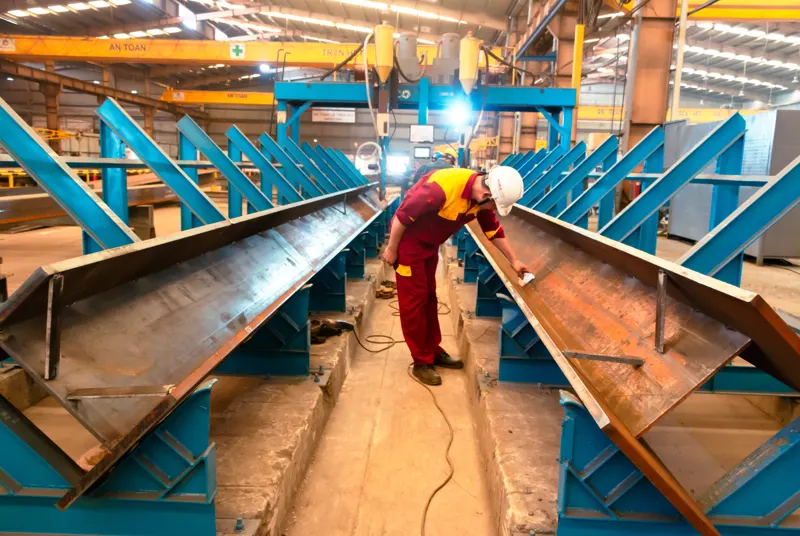
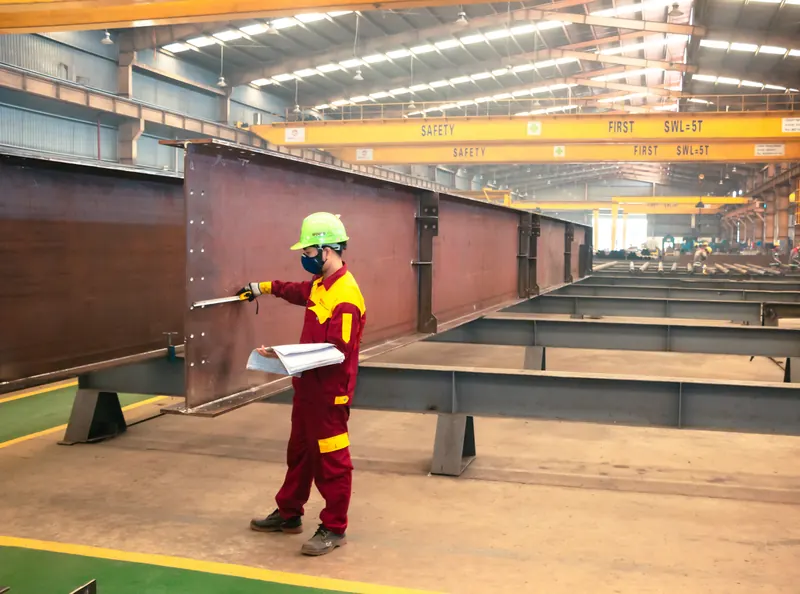
Visual inspection (VT) is required on all welds. The inspector checks size, profile, undercut, porosity, cracks and craters against AWS acceptance criteria. Good lighting, gauges and a trained eye catch the large majority of defects.
Nondestructive testing: selected welds
When the specification or the code requires it, welds are also tested with one of these methods:
| Method | What it finds | Typical use |
|---|---|---|
| Ultrasonic testing (UT) | Internal flaws in thick welds | Complete-joint-penetration groove welds, moment connections |
| Magnetic particle testing (MT) | Surface and near-surface cracks | Fillet welds, weld toes, root passes |
| Penetrant testing (PT) | Surface-breaking flaws | Non-magnetic materials, small areas |
| Radiographic testing (RT) | Internal flaws | Rare in buildings, more common in bridges and piping |
AISC 360 sets default testing rates for different risk categories, and AISC 341 increases them for seismic welds. The Engineer of Record can raise or lower rates within the code's rules.
Seismic welds and AWS D1.8
In seismic force-resisting systems, some welds are classed as demand-critical. For these, AWS D1.8 requires filler metals with specified notch toughness, procedures qualified for the purpose, and additional inspection. A fabricator supplying seismic steel should show WPS and welder records qualified to AWS D1.8, not only D1.1. World Steel's shop has AWS D1.8-qualified procedures and welders for this work.
What the records should show
For each tested weld, the record should identify:
- the member mark and joint;
- the welder;
- the method, technician and certification level;
- the acceptance standard and result;
- any repair and its re-test.
Records like this let the special inspector and the Engineer of Record review results quickly, and they remain useful for the owner long after the building is occupied.
Who inspects
Two roles are often confused. Quality control is the fabricator's own inspection: its inspectors check fit-up, welding and finished welds and keep the records. Quality assurance is done for the owner, usually by a special inspector or testing agency hired by the owner or the contractor. AISC 360 and AISC 341 list the tasks for each role, and many tasks appear in both columns.
The fabricator's inspectors should be qualified, commonly as AWS Certified Welding Inspectors or to an equivalent recognised scheme. Ask for their qualifications as part of the submittal.
Common NDT methods
Ultrasonic testing is the usual method for complete joint penetration groove welds in structural steel. Magnetic particle testing finds surface and near-surface cracks in fillet welds and at weld toes. Radiographic testing is used less on buildings because of safety and access, but some specifications still call for it. The test method, the acceptance criteria and the sampling rate should all be in the contract documents.
Rates and sampling
The design documents usually set a testing rate, for example a percentage of welds of a given type. Some specifications allow the rate to be reduced when the rejection rate stays low, and require it to increase when it rises. Agree in advance how the rate is tracked and who decides when it changes.
Inspection test plan
An inspection test plan lists each inspection step, who performs it, the reference standard and whether it is a hold point. World Steel prepares a sample plan, and the inspection items and rates are agreed by both parties for each project. A clear plan stops arguments about what was supposed to be checked.
Remote and on-site QA
When the owner's inspector cannot be at the plant for every hold point, live video and online records can cover part of the work. On-site visits at key milestones, such as the first members of each type, are still worth the trip. Remote inspector access is available at World Steel on request.
Repairs
Defects found by inspection are repaired to an approved procedure and re-inspected. A low repair rate is a sign of a well-run shop; a hidden one is a warning. Ask for repair rates as part of the fabricator's quality reporting.
Quick answers
Are all welds ultrasonically tested?
No. Visual inspection applies to all welds. Ultrasonic testing is normally specified for complete-joint-penetration groove welds in certain members, at a rate set by AISC 360 or AISC 341 and the project specification.
What is a demand-critical weld?
A weld in a seismic force-resisting system whose failure would seriously reduce the structure's performance. AISC 341 identifies them, and AWS D1.8 adds requirements for their filler metal, procedures and testing.
Who certifies the inspector?
Visual inspectors are usually AWS Certified Welding Inspectors or equivalent; NDT technicians are certified to a written practice such as ASNT SNT-TC-1A.
Keep building your steel plan
Go further on USPEB.com
On this topic
Across the US market
- Quality hubInspection, testing and sign-off at the plant
- IAS AC472 accreditationThe first and only AC472 plant in Vietnam
- Accredited testing labsILAC ISO/IEC 17025 testing on every project
- Online factory auditWalk the shop live with our QA team
- Large projects, 2,500 t a monthCapacity for large US general contractors
- Contractor partnershipLong-term supply for US contractors