When a general contractor asks a fabricator "what is your lead time?", the honest answer is a chain of steps, each with its own owner. Seeing the chain is the first step to shortening it.
1. Award to start of detailing
The fabricator needs the latest drawings, the design criteria and the scope split before detailing starts. If the bid package was complete, this takes days. If the award triggers a round of scope clarifications, it can take weeks.
Shorten it: send a conformed set and a signed scope matrix with the award letter.
2. Shop drawings and connection design
Detailers produce erection drawings, piece drawings and, where delegated, connection calculations. On a typical large package the first sequence can be ready for review within two to three weeks.
Shorten it: agree the sequence order up front and release drawings by sequence, not all at once.
3. Review and approval
This is where most schedules slip. Each review round passes through the general contractor, the Engineer of Record and sometimes the architect. One week per round per party adds up quickly.
Shorten it: agree review turnaround times in the subcontract, hold a weekly drawing call and resolve comments live instead of by marked-up PDF.
4. Material
Common shapes and plate are usually in stock or quickly available. Special grades, heavy plate, large HSS and material with impact testing can take longer. A fabricator that buys material against the approved first sequence saves time.
Shorten it: flag special materials at award so they can be ordered before drawings are final.
5. Fabrication
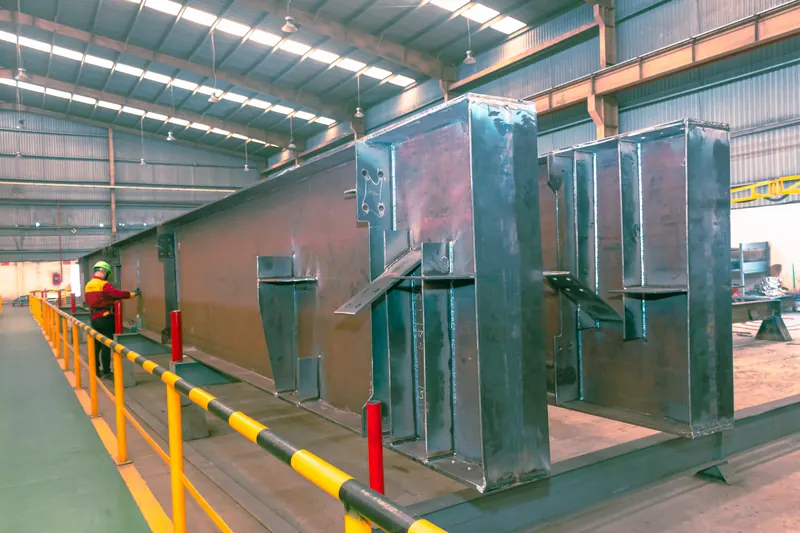
Cutting, drilling, fitting and welding are the part most people picture, and in a large, well-run plant they are rarely the bottleneck. A plant producing 2,500 t a month fabricates a 500 t sequence in a matter of weeks.
6. Blasting, coating and inspection
Surface preparation and coating need curing time between coats; galvanizing adds a trip to the kettle. Inspection hold points must be booked with the inspector.
Shorten it: schedule inspector visits or live video inspections at award, not when the steel is ready.
7. Packing and loading
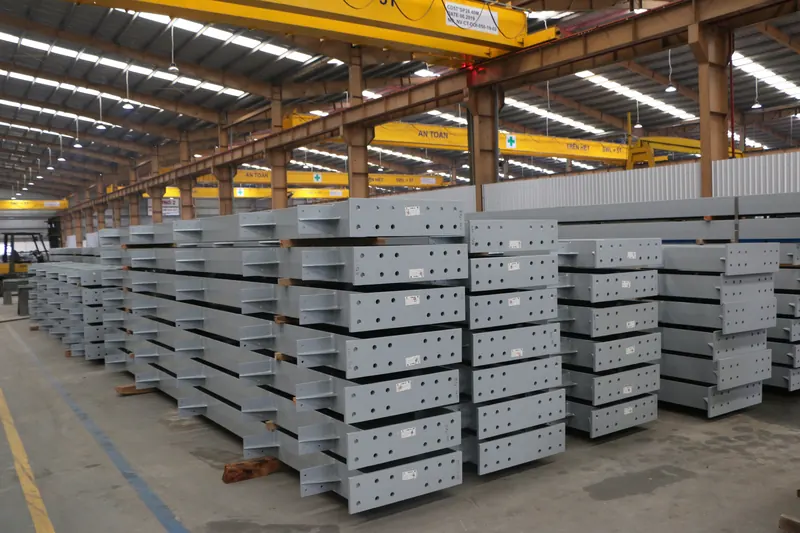
Packing in erection order, with labels and packing lists, takes a little longer in the plant and saves much more on site.
8. Ocean freight, customs and delivery
From Vietnam, port-to-port transit to the US West Coast is roughly three weeks and longer to the Gulf and East Coast. Add loading at origin, customs clearance and the truck leg to site. The shipping simulator shows the legs for each US port.
Where time is lost
Most delays in an overseas steel package do not happen in the shop or at sea. They happen in the gaps: drawings waiting for approval, RFIs waiting for answers, design changes arriving after fabrication has started, and shipments waiting for documents. A schedule that shows each handover, and who owns it, makes these gaps visible.
Overlap where it is safe
Sequences can overlap. Detailing of the second sequence can run while the first is in review, and fabrication of the first can start while the second is still being approved. The shop can buy material for the whole package once the main sizes are fixed, even before every connection is final. Agree with the Engineer of Record which parts can be released early.
Capacity in the delivery window
Lead time also depends on what else is in the shop. A plant running at 2,500 t (2,750 short tons) a month, like World Steel's, can take a large package without pushing other work aside, but only if the booking is made in time. Ask for a slot early, and confirm it once the contract is signed.
Putting it together
| Step | Typical owner | Where time is lost |
|---|---|---|
| Detailing | Fabricator | Incomplete bid package |
| Approval | GC, Engineer of Record | Slow review rounds |
| Material | Fabricator | Special grades ordered late |
| Fabrication and coating | Fabricator | Inspection not booked |
| Freight and customs | Fabricator or GC (per Incoterms) | Missing documents, port congestion |
The lesson is simple: the steps outside the shop take the most time, and most of them are controlled by the buyer as much as by the fabricator. A shared schedule with named owners for every step is the most effective lead-time tool there is.
Quick answers
What is the longest step in a steel schedule?
On most projects it is the shop drawing and approval cycle, not fabrication. Two review rounds with slow turnarounds can take longer than fabricating the steel.
Can fabrication start before all drawings are approved?
Yes, by sequence. Approving the first erection sequence early lets the shop start while later sequences are still in review.
How long does ocean freight from Vietnam take?
Port to port to the US West Coast is roughly three weeks, longer to the Gulf and East Coast. Add time for loading, customs and the inland leg.
Keep building your steel plan
Go further on USPEB.com
Across the US market
- US general contractorsHow we support GCs, steel erectors and developers
- Lower cost, lower riskWhere overseas fabrication saves on large jobs
- Section 232 steel importsDuties and paperwork on imported steel
- Landed cost calculatorFreight, duty and fees to your US jobsite
- Large projects, 2,500 t a monthCapacity for large US general contractors
- Contractor partnershipLong-term supply for US contractors