For most beams and columns, a rolled W-shape off the mill is the simplest and most economical choice. But rolled sections come in fixed sizes, and once spans, loads or depth limits go beyond them, a welded plate girder is often better. Here is how to decide.
What each one is
- Rolled W-shapes are produced in one piece at a rolling mill, in standard sizes listed in the AISC Manual.
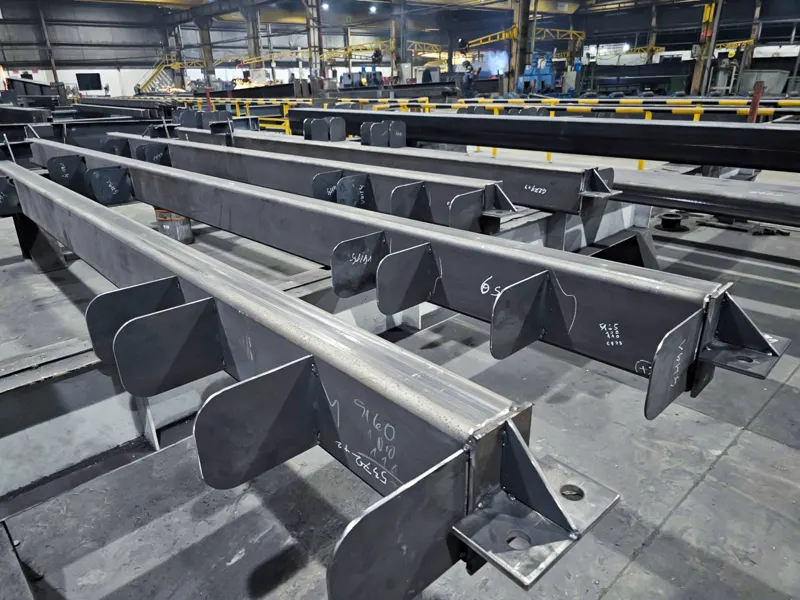
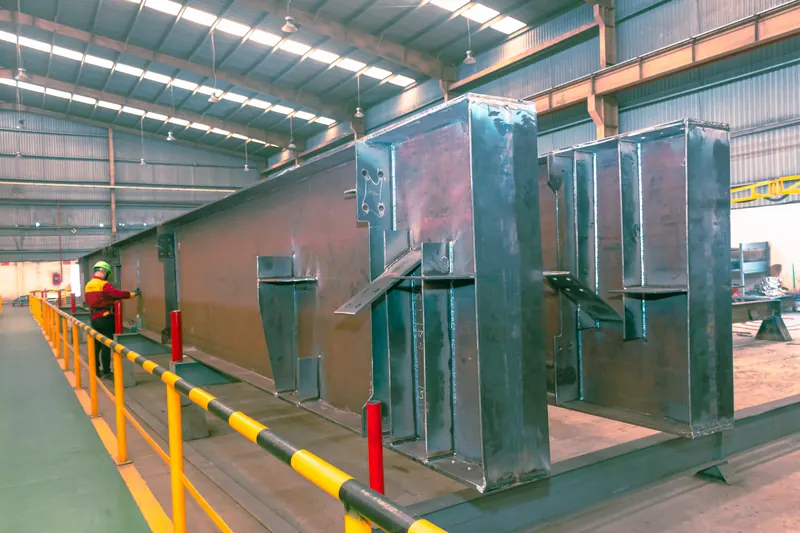
- Plate girders, also called built-up sections, are made by cutting flanges and a web from plate and welding them together, so every dimension can be chosen.
When rolled shapes win
- Typical spans and loads, where a standard size works without much spare capacity.
- Simple connections and many identical members.
- Fast availability, when common sizes are in stock.
When plate girders win
Long spans and heavy loads. Transfer girders, crane girders and long-span roof girders often need more depth or flange area than the largest rolled sections offer.
Depth limits. When ceiling height is tight, a shallower girder with heavier flanges can carry the load in less depth.
Tapered members. A web that is deeper where the moment is high and shallower elsewhere saves steel. Pre-engineered building frames are built this way.
Weight efficiency. Choosing flange and web thicknesses for the actual forces avoids paying for the spare steel of the next rolled size up.
Special shapes. Box columns, cruciform columns and asymmetric sections for architectural or seismic needs are built up by necessity.
Fabrication matters
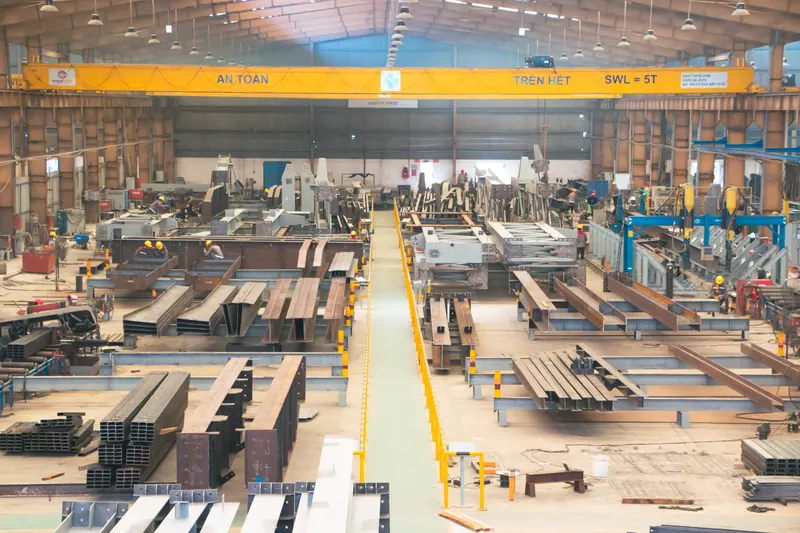
A plate girder is only economical if the shop makes it efficiently. A modern plant cuts flanges and webs by CNC, assembles them on an H-beam line and welds them with submerged arc welding. World Steel's laser machines cut and make holes in steel up to 100 mm thick, and the plant makes box and cruciform sections as well as I-girders.
Points for the designer
| Topic | Check |
|---|---|
| Web slenderness | Stiffeners or a thicker web to prevent buckling |
| Flange-to-web welds | Size for shear flow, and fatigue for crane girders |
| Lateral bracing | Compression flange bracing spacing |
| Camber | Specify if needed; it is easier to build into a welded girder |
| Material | Plate grade and, if required, impact testing |
Depth and span
Rolled wide-flange beams are available up to a certain depth and weight. When a span or load needs more depth than the largest economical rolled shape, a plate girder becomes the practical choice. Transfer girders carrying columns, long-span roof girders and crane runway girders often fall into this range.
A plate girder can also be made deeper in the middle and shallower at the ends, or with flanges that change thickness along the length. That puts steel where the moment is highest and can save weight compared with a constant rolled section.
Webs, flanges and stiffeners
Plate girders usually have slender webs, which makes web stability a design question. The designer chooses between a thicker web with fewer stiffeners and a thinner web with more stiffeners. Stiffeners take time to fit and weld, so a slightly heavier web often costs less overall. Ask the fabricator early which option suits its shop.
Flange-to-web welds are usually fillet welds made by submerged arc welding on automatic equipment. Where the design needs complete joint penetration welds, for example in some fatigue-loaded girders, the welding and testing take more time and should be planned.
Camber and tolerance
Long girders often need camber to offset dead-load deflection. Rolled beams are cambered cold, within limits. Plate girders can be cambered by cutting the web to the cambered profile before assembly, which gives more control. The fabricator should state the camber tolerance it will hold and how it will be measured.
Shipping limits
Very long or deep girders can exceed shipping limits. A girder over about 3 m (10 ft) deep or 18 m (60 ft) long may need splices, special trailers or breakbulk shipping. Agree splice locations with the Engineer of Record during design, not after the shop drawings are drawn.
Laser cutting and drilling
World Steel cuts plates up to 100 mm (4 in) thick and makes holes with laser machines, which keeps web and flange edges accurate and holes in the right place for bolted splices.
Make the choice early
The decision between rolled and built-up members affects connection design, detailing time and material orders. Ask the fabricator for input during design development: a short review of the main members often finds savings without changing the architecture.
Quick answers
Are welded plate girders heavier than rolled beams?
Usually lighter for the same capacity, because flange and web sizes are chosen for the job instead of taken from a fixed list.
Can plate girders be tapered?
Yes. Tapered webs follow the bending moment, which is the basis of most pre-engineered building frames.
What thickness can World Steel cut?
World Steel's laser machines cut and make holes in steel up to 100 mm thick.
Keep building your steel plan
Go further on USPEB.com
On this topic
Across the US market
- US codes and standardsIBC, AISC, AWS and MBMA, designed to
- Seismic steel structuresSDC D to F framing for West Coast jobs
- Crane building designUS crane standards for mill and bay buildings
- Design ReportWhat our US-code design report contains
- Contractor partnershipLong-term supply for US contractors
- Solutions by stateState-by-state steel solutions