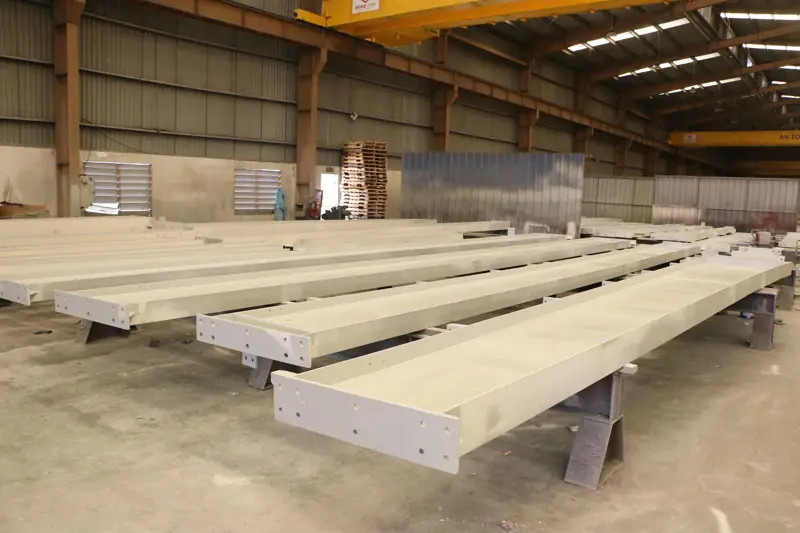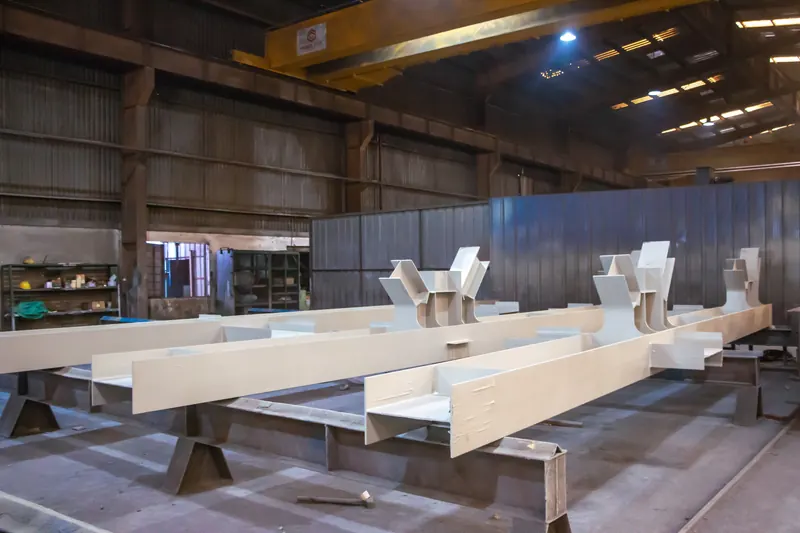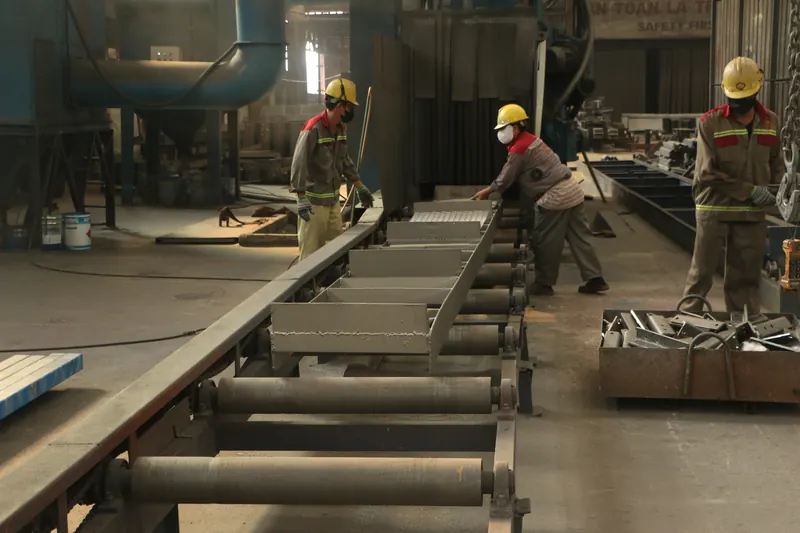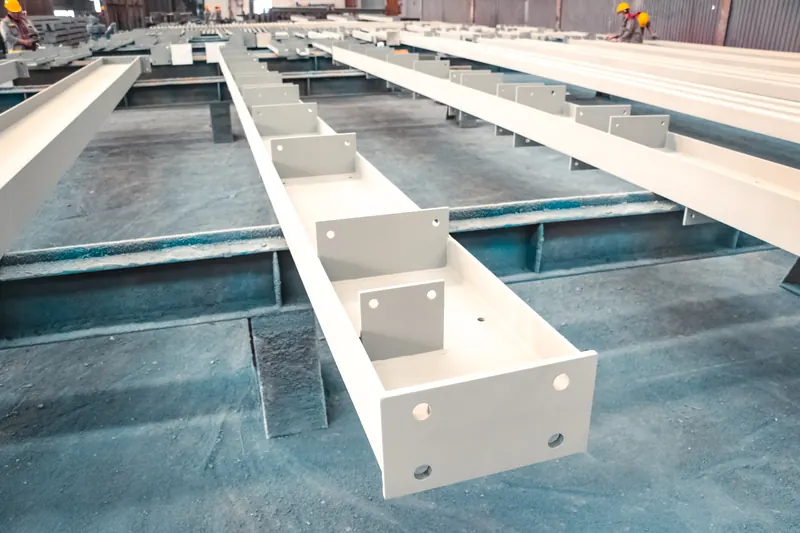
One of the coating decisions on every steel package is where the coats are applied. Some specifications call for shop primer only, with finish coats on site. Others ask for the full system in the shop. Each choice has its place.
Why shop application usually gives better results
A paint shop controls the things that decide coating quality:
- Surface preparation: blast cleaning to the specified standard and profile, under cover.
- Temperature and humidity, kept within the manufacturer's limits.
- Film thickness, measured and recorded on every member.
- Curing time between coats.
On site, the same work happens at height, in the weather, often after erection when access is hard.
When primer only makes sense
- Concealed steel inside a conditioned building, behind finishes.
- Steel to receive fireproofing: sprayed fire-resistive materials and some intumescent systems need a compatible primer or bare steel. Check the fire protection product listing.
- Steel to be encased in concrete.
- Final colour not decided at the time of fabrication.
When the full system belongs in the shop
- Exposed exterior steel and steel in corrosive interiors.
- Long ocean transport: a full system resists handling and salt air better than primer alone.
- High access costs on site, such as tall frames or occupied facilities.
- Architecturally exposed steel, where uniform finish matters.
Transport and erection damage
Whatever the choice, some damage happens in loading, shipping and erection. Plan for it:
- Pack with timber dunnage and soft slings; protect edges.
- Ship touch-up material with the steel, or name the product so the US contractor can buy it locally.
- Include a touch-up procedure in the submittal.
Using a coating from a manufacturer sold worldwide, such as Jotun, PPG, Carboline, Hempel, Nippon or International Paint, makes this easy: the same product is available near the jobsite.
Surfaces to keep clear
Mark on the shop drawings any surfaces to be left unpainted or masked:
- faying surfaces of slip-critical bolted joints, unless a coating qualified for the slip class is used;
- areas within a set distance of field welds;
- surfaces to receive shear studs or concrete.
Surface preparation sets the result
Whatever goes on, the coating will only perform as well as the surface beneath it. Blast cleaning to the specified standard, such as SSPC-SP 10 near-white or SSPC-SP 6 commercial, removes mill scale and rust and gives the profile the primer needs to grip. In a shop, blasting happens under cover with controlled equipment and can be checked on every member. On site, the same work is slower, weather-dependent and harder to inspect.
Ask the fabricator for the blast standard, the profile depth and how both are measured. Profile is usually checked with replica tape or a surface profile gauge, and recorded with the coating records.
Coating records
A shop that applies the full system should record, for each lot, the surface preparation, ambient conditions, product batch numbers and dry film thickness of each coat. Those records support the paint manufacturer's warranty and give the owner proof of what was applied. With primer only, the record stops at the first coat, and the finish coats depend on the field painter's records.
Recoat windows
Every coating has a minimum and maximum time before the next coat. If a shop-primed member waits on site longer than the primer's recoat window, the surface may need cleaning or light abrasion before the finish coat goes on. That is a common hidden cost of primer-only packages on projects with long gaps between delivery and painting.
Products you can buy in the US
Touch-up and repair are easier when the shop uses a system that is sold in the US. World Steel works with Jotun, PPG, Carboline, Hempel, Nippon and International Paint, whose products are available worldwide, so the field painter can buy the same product for touch-up and the manufacturer's warranty stays intact. World Steel's painters are trained and certified by the paint manufacturer.
Write it into the specification
State in the bid package which coats are shop-applied, which are field-applied and who is responsible for touch-up after erection. Without that line, bids are hard to compare.
A simple rule
If the steel will be seen, exposed to weather or hard to reach later, put the full system on in the shop. If it will be hidden, encased or fireproofed, primer only is often right. Either way, ask for the coating records: they show what was actually applied.
Quick answers
How long can primed steel sit before topcoating?
Each primer has a maximum recoat interval in its data sheet. Beyond it the surface may need cleaning or abrading before the next coat.
Which surfaces are left unpainted?
Faying surfaces of slip-critical connections (unless a qualified coating is used), surfaces to be field welded and steel to be encased in concrete or fireproofing that needs bare or primed steel.
Who touches up damage on site?
The US contractor, as erector, normally touches up transport and erection damage with products and procedures from the fabricator's coating system.
Keep building your steel plan
Go further on USPEB.com
On this topic
Across the US market
- Steel fire protectionIntumescent and fire-rated steel packages
- Quality hubCoating inspection by FROSIO Level III inspectors
- Products catalogGalvanized, painted and built-up members
- Download centerSample ITP, design report and approval drawings
- Large projects, 2,500 t a monthCapacity for large US general contractors
- Contractor partnershipLong-term supply for US contractors